There’s a pattern we keep seeing in RevAI RealTalk™ conversations with B2B go-to-market teams right now.
Everyone is trying to go faster. Marketing is trying to sharpen targeting and convert more demand. SDR leaders are trying to increase activity and meetings. Sales leaders are trying to improve deal progression and forecast accuracy. RevOps is trying to clean up process, restore data trust, and keep the whole machine from wobbling off its rails.
On its own, each move makes sense. Each team is solving a real problem.
But taken together, something else happens.
The stack gets bigger. The motion gets noisier. And somehow, even with more technology than ever, execution still feels harder than it should.
That’s because most companies don’t actually have a tool problem. They have a system design problem.
A stack can be impressive on paper and still fail in practice.
A system is different. A system has flow. It has logic. It has ownership. It has feedback loops. It is designed around what must happen next.
This is one of the distinctions we keep coming back to. A revenue stack is what you buy. A revenue system is what you design.
And that shift, from stack to system, is the one we believe more GTM teams need to make right now.
Because when every team keeps adding roads, ramps, and shortcuts to improve its own commute, but no one is thinking about the city as a whole, you don’t get speed.
You get traffic.
Tool sprawl is usually discussed as a budget problem. Too many licenses. Too many overlapping vendors. Too much shelfware.
But that’s not the part we find most interesting.
The real cost of tool sprawl is operational.
It shows up in the quiet, everyday friction that slows a business down without anyone putting it on a slide. It shows up when teams have to keep re-explaining the purpose and value of tools to one another. It shows up when the same buyer signal is interpreted differently across teams. Marketing sees engagement, Sales sees opportunity, and RevOps sees a data event. It shows up when handoffs become manual, when routing rules become tribal knowledge, and when managers end up inspecting noise instead of reality.
This is the invisible tax of stack thinking.
And it’s why “more tools” so often feels like progress while the actual buyer experience still feels fragmented.
A stack is what you buy. A system is what you design.
That distinction matters more than it sounds.
Because once you start looking at your GTM environment as a system, a different set of questions appears:
That’s where the real leverage lives.
This isn’t just an internal operations issue. Buyers are forcing the change too.
Modern B2B buying doesn’t behave like a neat, linear funnel anymore, if it ever truly did. Buyers research anonymously. They compare vendors across channels. They talk to peers. They loop in multiple stakeholders at different moments. They revisit the same problem several times before a deal ever appears in your CRM.
That means your GTM motion has to do something harder than most teams admit.
It has to support self-directed digital behavior and coordinate the right human action at the right time.
That’s why a lead-based mindset breaks down so quickly now. It fragments reality. One person fills out a form. Another attends a webinar. A third visits the pricing page. A fourth replies to outbound. If your system treats all of that as disconnected lead activity, you lose the account’s actual story.
And if you lose the account story, you lose the buyer story.
A modern Revenue System needs an account-based lens, not because ABM is fashionable, but because that is the only way to organize reality in a way that matches how complex B2B buying actually works.
That doesn’t mean every company needs to become a perfectly mature ABM organization overnight. Plenty of teams are hybrid today, and that’s fine. But it does mean the Account object should become the organizing object for signals, ownership, orchestration, and measurement.
That is what makes the rest of the system possible.
Once you stop thinking in stacks, the landscape becomes easier to read.
At the bottom is the Foundation. This is the truth layer: CRM, data, integrations, governance, permissions, and reporting. It’s not glamorous, but it is decisive. If the foundation is messy, every layer above it gets noisier. AI won’t fix bad truth. It will amplify it.
This layer usually sits with RevOps, Systems, Marketing Ops, Sales Ops, and IT. In most organizations, this is where platforms like Salesforce, HubSpot, Dynamics, Snowflake, Databricks, Workato, or MuleSoft show up.
Above that is Upstream Intelligence. This is where the business tries to understand where to focus and why now. It includes account selection, intent, buying-stage clues, web behavior, market signals, and early account research.
Marketing and ABM teams tend to live here most naturally, with RevOps helping make the data usable and Sales consuming the output. This is where you’ll see tools like 6sense, Demandbase, ZoomInfo Marketing, RollWorks, Bombora, G2, and first-party website or product signals.
Then comes the layer we think deserves far more attention than it gets: Bridge Capabilities. This is where raw intelligence gets translated into something a team can actually act on. Enrichment, normalization, lead-to-account matching, routing, segmentation, activation, workflow logic. This is the connective tissue between “we know something” and “we’re doing something.”
RevOps, Marketing Ops, and Sales Ops often carry this layer, whether they call it that or not. Tools here might include LeanData, LeadAngel, Openprise, Syncari, RingLead (ZoomInfo OperationsOS), Clay, Census and Hightouch (reverse ETL / composable CDP), HubSpot Data Sync, Salesforce automation, or 6sense Data Workflows, all focused on turning signals into clean, routed, execution-ready data.
After that comes Midstream Engagement. This is where the active conversations happen and where the buyer actually experiences your GTM motion. Inbound conversion, outbound engagement, calls, meetings, and seller workflows all sit here.
SDRs, BDRs, and Sales live in this layer every day, with Marketing owning parts of inbound conversion. This is where tools like Qualified, Drift, Intercom, Outreach, Salesloft, Apollo, HubSpot Sales Hub, ZoomInfo Sales, Aircall, Dialpad, and 6sense AI Email, powered by upstream signals, show up.
Then you reach Downstream Execution. This is where the system becomes operational. It’s where teams coordinate next steps, inspect deal and pipeline health, reduce risk, improve forecast confidence, and scale the plays that work. Sales leadership, RevOps, and Enablement usually converge here.
This is where categories like revenue intelligence, deal inspection, pipeline governance, enablement, and emerging revenue orchestration platforms start to matter. It’s also where tools like Clari, Gong, Outreach, Salesloft, Seismic, Highspot, DealHub, and Gainsight are likely to sit.
And across all of it sits the AI Layer. Don’t think of AI as just another box in the stack. It’s better understood as a multiplier across the entire system.
Whether it’s predictive, generative, conversational, or agentic, AI can assist with research, content generation, enrichment, forecasting, qualification, workflow automation, and decision support.
But AI thrives on clean data. When data hygiene is strong and context is reliable, AI accelerates the system. When it isn’t, AI simply helps you go faster in circles.
ChatGPT, Claude, Microsoft Copilot, HubSpot Breeze, Salesforce Agentforce, AI SDRs, and other copilots or agents all fit here in different ways.
Once you see the system this way, the conversation changes. You stop asking whether your stack is “modern” and start asking whether it is “designed.”
If there’s one layer more teams overlook than any other, it’s the Bridge layer.
That’s interesting, because the Bridge is often where the system either becomes real or quietly falls apart.
Most teams naturally obsess over signals, engagement tools, and AI. Signals feel strategic. Engagement tools feel tangible. AI feels urgent.
The Bridge feels, well..., operational.
And that is exactly why it gets underestimated.
But here’s the truth: good signals do not create pipeline on their own. They need to be translated into execution-ready inputs.
When we say “signals,” we’re talking about observable signs that something relevant is happening. That could mean account intent surges on topics that matter. It could mean target accounts visiting key pages on your website. It could mean product usage spikes, demo requests, webinar attendance across the buying group, email replies, pricing-page visits, stage slippage, or missing stakeholders in active deals.
Signals are everywhere. The problem is rarely their existence. The problem is that they live in different tools and never get connected to a coherent next step.
The same is true for engagement tools. These are the systems teams live in every day: conversational marketing tools, outbound platforms, call systems, meeting tools, conversation intelligence, and workflow surfaces embedded in CRM. They are close to the action, which makes them feel central. But they still depend on the Bridge to know who should be contacted, by whom, in what sequence, and with what context.
And AI? Same story.
In one organization, AI means an SDR agent. In another, it means a generative email copilot. In another, it means a predictive forecasting assistant, a research bot, or an automation layer that triggers tasks. The issue isn’t whether those tools exist. It’s whether the system can provide them with a clear context and turn the output into accountable action.
That’s why the Bridge matters so much.
In practice, the Bridge usually follows a sequence:
When that sequence is weak, everything downstream gets weaker too. Sellers work bad lists. Inbound gets routed poorly. Marketers can’t trust activation. Managers inspect noise. AI agents fire with incomplete context.
This is why those of us who see the chaos keep coming back to the Bridge. It’s the layer that receives the least applause and causes some of the biggest breakdowns.
Even when teams understand the layers, they often make one more mistake.
They assume that once the technology is mapped, the job is done.
It isn’t.
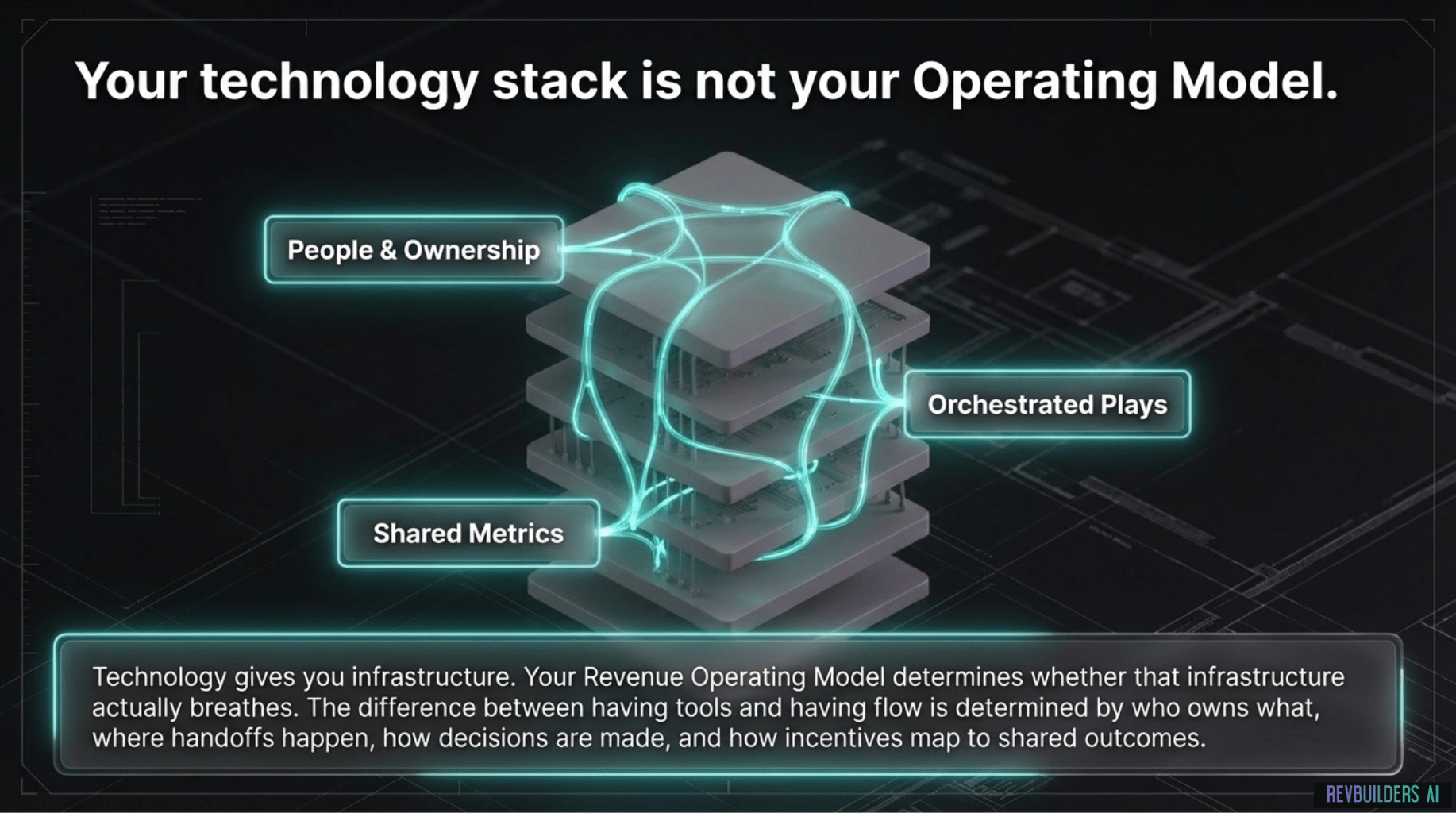
Technology gives you infrastructure. Your Revenue Operating Model determines whether that infrastructure actually works.
The operating model decides who owns what. It defines where handoffs happen. It determines which metrics matter, how decisions get made, and how incentives ladder into shared outcomes.
In other words, it is the difference between having tools and having flow.
This is where we think teams need to shift the question.
Instead of asking, “Which team owns this tool?” a better question is, “Which layer of the system is this tool serving, and what role does each team play there?”
That sounds subtle, but it changes everything.
Because once you organize the conversation around the system, ownership becomes clearer:
Once you frame the model this way, alignment becomes easier to see. It also becomes easier to diagnose when it is missing.
This is where the redesign gets real.
Because the operating model is not just about ownership. It is also about metrics, incentives, and shared definitions of success.
Each layer will always have its own local metrics. That’s normal. Upstream Intelligence may care about account coverage, account progression, buying-group density and engagement, or signal quality. The Bridge may care about routing accuracy, match rates, enrichment completeness, or activation speed. Midstream Engagement may care about response quality, meeting conversion, and stakeholder penetration. Downstream Execution may care about progression, slip rate, win rate, and forecast confidence.
The issue is not that these metrics exist.
The issue is what happens when they do not ladder into shared outcomes.
That’s when Marketing can hit MQL goals while Sales complains about quality. It’s when SDRs can crush activity while pipeline stays flat. It’s when RevOps can improve data hygiene while managers still coach from inconsistent information.
That’s why the Revenue Operating Model must align around shared progression, not isolated activity.
If you want to go deeper on that specific question, this is exactly where our ABM Metrics & Attribution in 2026 piece becomes useful. It’s the companion conversation to this one. Not just how the system is designed, but how the metrics inside it should actually work.
The other place this model becomes real is in plays.
Not abstract “alignment.” Not theoretical transformation.
Plays.
That is where layers become connected. That is where the system stops being a diagram and starts becoming a motion.
That’s the difference.
A stack can be busy. A system can be accountable.
The good news is that you do not need to rebuild everything at once. But you do need to stop layering new tools on top of an unclear overarching design.
If we were helping a team start such a project, we’d begin by mapping every tool to a system layer. If a tool does not map clearly, that is already useful information. It may be redundant. It may be orphaned. Or it may be poorly understood.
From there, we would make the Account the organizing object, even if you’re still operating in a hybrid model. That single move improves a surprising number of downstream design decisions.
Then we would focus on Foundation and Bridge layers before adding more AI. Not because that’s the glamorous work. Indeed, it isn’t. But because that is the work that makes everything else function.
After that, we would define two or three core plays and instrument them end-to-end. And finally, we would align ownership and metrics around those plays, rather than around isolated tools.
That is where a Revenue System starts to become real.
And again, if the metrics side of that conversation is the sticking point, check out the ABM Metrics & Attribution in 2026 piece as your next-best read.
The future of Revenue AI is not about adding more tools. It is about building a system where signals, teams, workflows, and execution move in sync.
That is the real advantage.
Not more dashboards. Not more automation. Not even more AI.
Simply, a better-designed system.
Here’s to turning insight into action,
~ Nikke
Keep building the system
If this stack-to-system lens is useful, subscribe to RevAI Real Talk for practical frameworks, patterns, and next-step guidance on designing Revenue AI systems that actually work in the real world.
Ready to operationalize it?
If your team is done with tool sprawl and ready for a system that drives pipeline and predictability, the Revenue AI Accelerator™ Masterclass is our end-to-end program for designing and operationalizing Revenue AI, from foundation and governance through orchestrated plays that scale.