sales
signals
pipeline

This article reflects how we think about Revenue AI at RevBuilders AI, and why Gartner’s new RAO category marks a structural shift in how GTM teams should design their systems.
We’ve been noticing two overlapping trends among B2B GTM teams, and from what we're seeing, they’re a major driver of today’s tool sprawl.
Trend #1: Teams evaluate point solutions in silos to solve their immediate problem. Marketing optimizes for coverage and conversion. SDRs optimize for activity and meetings. Sales optimizes for pipeline movement and deal progression. RevOps optimizes for data integrity and forecast confidence. Each function asks different questions and, with separate budgets, buys tools to answer them.
Trend #2: Suite vendors continue to expand. Capabilities that used to be “a point tool” are now bundled into platforms, creating overlap (suite vs. point solution) and across suites.
Here’s the underlying issue: most companies don’t have a single owner of the end-to-end GTM operating system — the workflows, handoffs, KPIs, and incentives across the customer journey. Each department ends up buying “their” tools to optimize “their” slice, and the overall system becomes more fragmented.
It’s like building a city’s transportation network one neighborhood at a time. Every team adds a road, a ramp, or a shortcut to improve their commute. And, without an urban planner and shared traffic rules, you don’t get speed and flow… you get inefficiencies and congestion.
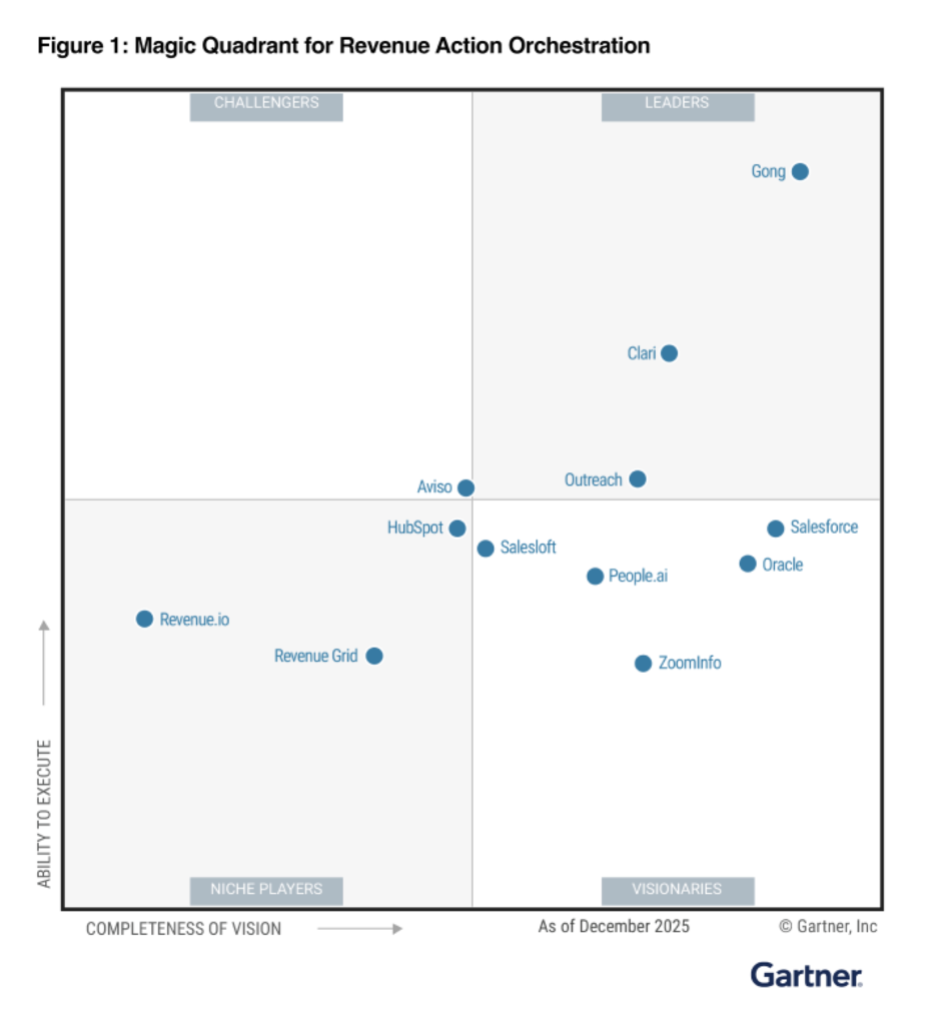
 And that's why this seemingly quiet entry stood out: In December 2025, Gartner published its first‑ever Magic Quadrant for Revenue Action Orchestration (RAO), marking a clear definition of RAO as a new category for AI and sales tech that unifies data, engagement, and automation with human‑in‑the‑loop controls.
To me, that’s a milestone signal, not because it’s “another category,” but because it reflects a shift from tools that inform to systems that coordinate action.
Every day, there’s a new AI feature, model, “agent,” or tool announcement. Most of it is incremental.
RAO shows up right now because a lot of organizations hit the same wall:
RAO is the market response to that gap: the missing layer between what GTM teams know and what they do next.
.png?width=3668&height=2048&name=Gartner-RAO_Stack-to-System%20(2).png)
B2B buyers are more digital, more self-directed, and more selective about when they want humans involved.
Which means the modern requirement is not “add AI."
It’s about building a Revenue AI system that supports how buyers buy.
A system that scales:
Most teams can list their tools. Yet, it seems almost nobody can explain how those tools work together as a closed-loop system.
And that gap creates a very real, yet mostly invisible tax on daily work and output.
.png?width=3668&height=2048&name=Gartner-RAO_Stack-to-System%20(28).png) When the stack isn’t designed as a system, typically two things occur:
When the stack isn’t designed as a system, typically two things occur:
1. GTM teams waste time level-setting each other's understanding of purpose, value, and ROI of each tool across roles (Marketing, SDRs, Sales, RevOps).
2. And a constant “taping together” of fragmented workflow steps between teams.
The cost compounds quickly: more meetings, more manual handoffs, more rework, less momentum.
When the stack is designed as a system, it has:
.png?width=3668&height=2048&name=Gartner-RAO_Stack-to-System%20(3).png)
The obvious question is:
“Okay… so where does RAO go in the stack?”
RAO isn’t “just another tool.” It’s what you could call the revenue execution hub: the layer that turns signals into prioritized actions and helps ensure those actions actually happen.
If the GTM stack is the orchestra, RAO is the conductor keeping every section aligned on timing, next moves, and the score.
Historically, teams tried to solve this gap with:
But “seeing” isn’t the same as orchestrating execution.
⚡️ Quick reality check: some teams are still running a legacy lead-based model, while others run hybrid ABM or full ABM.
A modern Revenue AI system assumes an account-based lens, because real deals aren’t “one person fills out one form.” They involve multiple stakeholders, multiple touchpoints, and extensive anonymous research, which only makes sense when signals roll up to an account (and ideally a buying group).
Good news: you don’t have to be “perfect ABM” to use this map. Many orgs start hybrid. The key is to treat the account as the organizing object for signals, orchestration, and outcomes — and let leads serve as supporting detail.
Here’s the simplest way to make sense of the modern GTM landscape (and who typically owns each layer):
.png?width=3668&height=2048&name=Gartner-RAO_Stack-to-System%20(4).png)
.png?width=3668&height=2048&name=Gartner-RAO_Stack-to-System%20(27).png)
.png?width=3668&height=2048&name=Gartner-RAO_Stack-to-System%20(22).png)
Here are a few repeatable system pattern examples:
Play 1: Intent → qualified meetings (without spamming people) | ABM + intent → bridge activation → inbound AI SDR/conversion → engagement → RAO guidance
Play 2: The lean outbound engine (GTM engineering style) | bridge activation → enrichment sources → outbound + deliverability → RAO prioritization
Play 3: Save deals already in pipe (where AI ROI often hides) | conversation signals → risk detection → orchestrated actions → enablement + coaching
⚠️ Prereqs (so these plays actually work):
.png?width=3668&height=2048&name=Gartner-RAO_Stack-to-System%20(19).png)
If you can’t answer these in plain English, you don’t have a system yet:
.png?width=3668&height=2048&name=Gartner-RAO_Stack-to-System%20(20).png)
RAO matters because it marks a shift from
to
.png?width=3668&height=2048&name=Gartner-RAO_Stack-to-System%20(13).png)
Here's to turning insight into action,
– Nikke
If this “stack to system” lens is useful, subscribe to RevAI Real Talk, a bi-weekly, no-hype set of field notes on what’s changing in Revenue AI, what actually matters, and one practical move you can apply this week to drive pipeline and predictability.
And if your team is done with tool sprawl and ready for a system that drives pipeline and predictability, the Revenue AI Accelerator™ Masterclass is our end-to-end program for designing and operationalizing Revenue AI — from foundation and governance through orchestrated plays that scale.
👉 Explore the masterclass.
Publishing notes: Gartner and Magic Quadrant are trademarks of Gartner, Inc. Gartner does not endorse any vendor, product, or service.
Likewise, I am not endorsing any vendor, product, or service in this article – all names mentioned are for the explicit purpose of providing context and clarity.
🔗 Links to Gartner-defined GTM market categories mentioned in this article:
🔗 And links to Gartner-defined foundation layer categories (not “GTM tools” per se, but absolutely part of the Revenue AI system):