


Skip to content
ABM Metrics and Attribution | RevAI Real Talk™
growth strategy attribution metrics

ABM Metrics & Attribution: Stop Measuring Account-Based Programs with Lead-Era Metrics

Nikke Rose
Nikke Rose

Why ABM is a corporate GTM strategy – not a marketing campaign – and how to replace lead-era reporting with account-based measurement across coverage, readiness, throughput, and yield.
 

ABM-Attribution_00

The real attribution problem in ABM

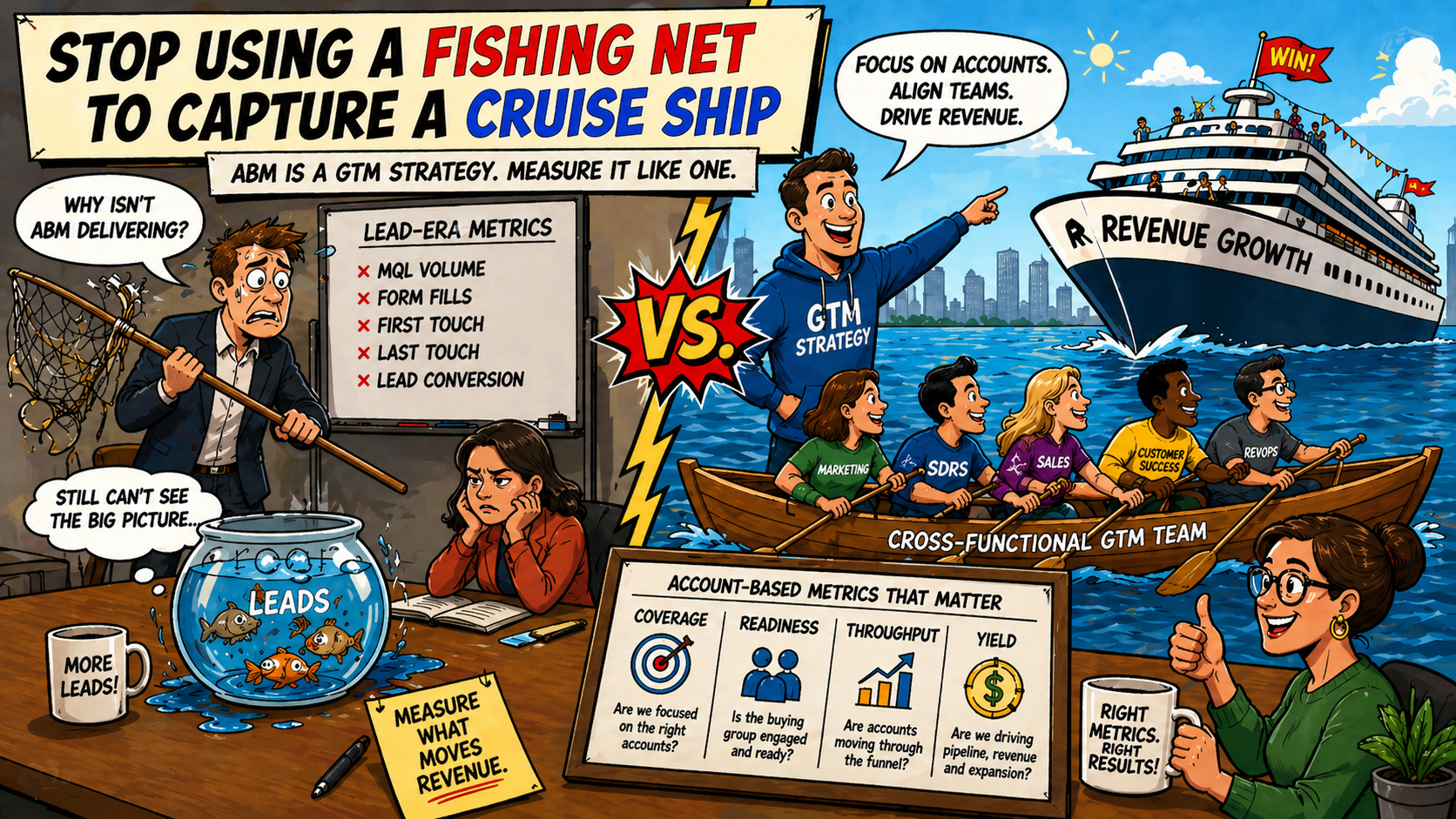
The problem is not that account-based marketing lacks measurable impact. The problem is that too many account-based programs are still evaluated with lead-era campaign metrics.

That may sound subtle, but it changes the whole conversation. When leaders ask an ABM team to prove performance using MQL volume, individual lead conversion, first-touch credit, last-touch credit, or campaign-sourced pipeline alone, they are asking an account-based motion to fit inside a lead-based measurement model.

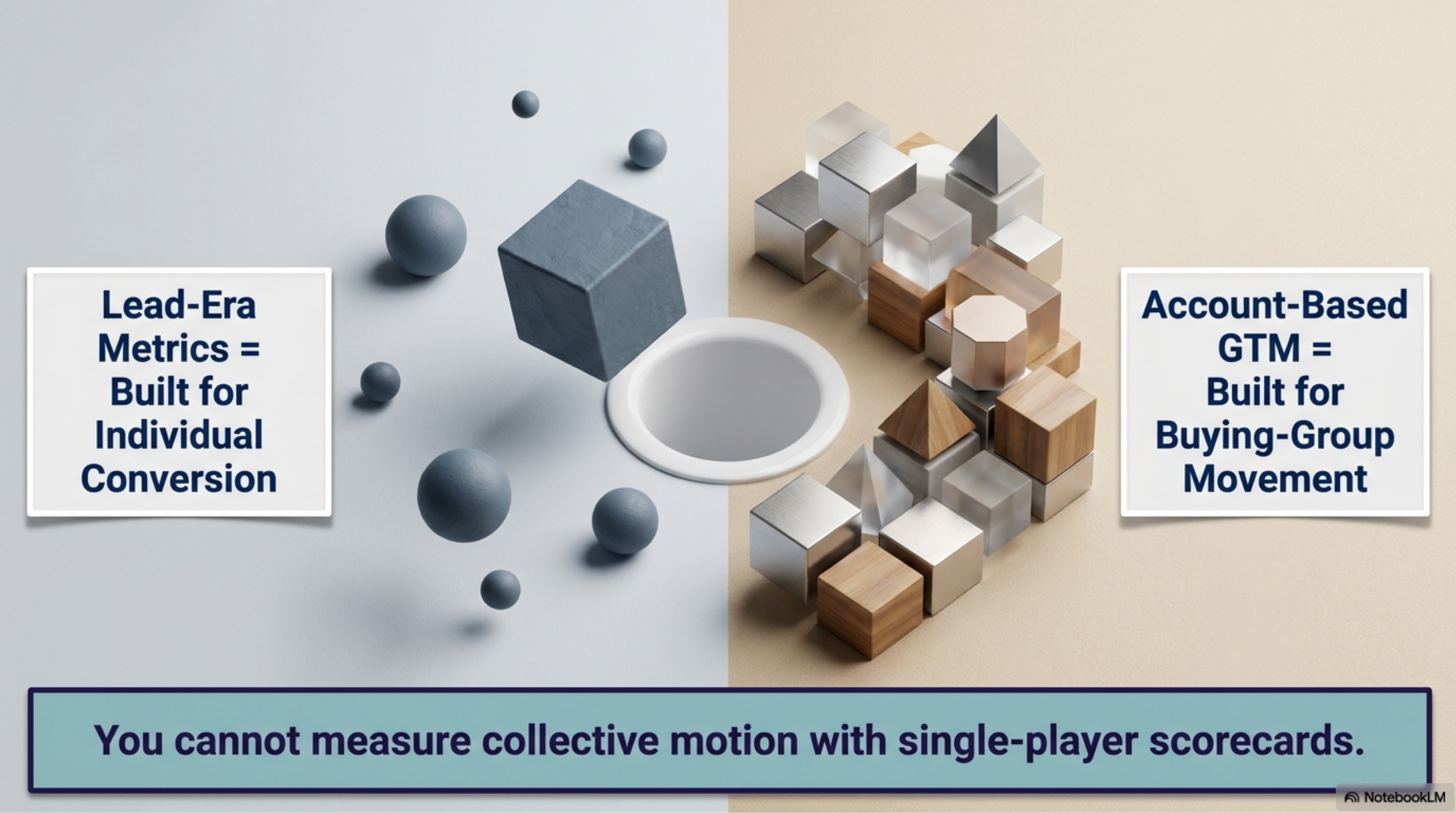
That is the square peg / round hole problem. Lead-era metrics were built for individual conversion. Account-based GTM is built for buying-group movement.

A form fill can tell you someone converted. It cannot tell you whether the buying group is moving.

ABM-Attribution_01

ABM is not a marketing side project

ABM only works when it is part of the broader GTM strategy, not a marketing side project.

That framing matters because ABM is not just a campaign motion. It depends on shared target account lists, coordinated engagement, and unified metrics across marketing, SDR, sales, RevOps, and customer success.

ZoomInfo makes this point clearly:

When teams work from different account lists or measure different metrics, they create activity, not pipeline.

💡 That is why the measurement model has to evolve. If ABM is a corporate GTM strategy, it needs GTM measurement. Not a campaign scorecard built for lead capture.

ABM-Attribution_02

Why lead-era metrics break account-based programs

Traditional campaign reporting usually asks: How many leads did we generate? How many converted? Which campaign gets credit?

Those are not useless questions. They can still help diagnose channel performance and touch-level influence. But they are not enough to evaluate an account-based program.

Forrester has been pushing the industry toward buying-group awareness for years, including the need to measure buying groups inside marketing automation and sales force automation systems. Their lead-based measurement critique points directly at the limitation of measuring impact one person at a time when buying decisions are collective.

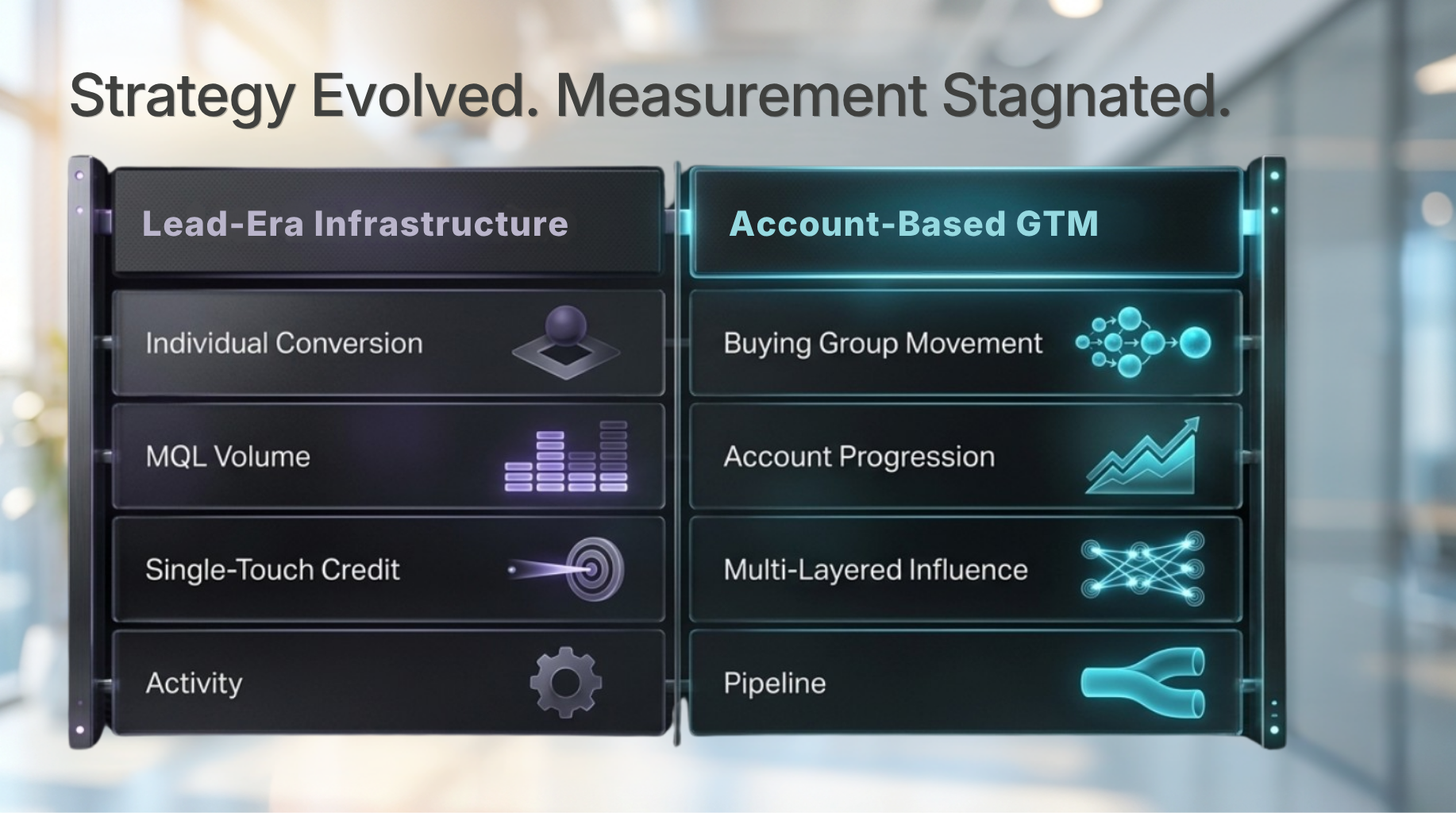
6sense has reached a similar conclusion in recent research. Its 2025 B2B marketing metrics report argues that modern approaches like ABM are often layered on top of lead-centric infrastructure, with teams still measured by MQLs even when buyers have moved beyond the MQL factory.

The report summarizes the gap well:

Strategy may be evolving, but measurement remains stuck in the past.

💡 That is exactly the disconnect this reset is meant to address.

ABM-Attribution_03

Reframing: KPI replacement model

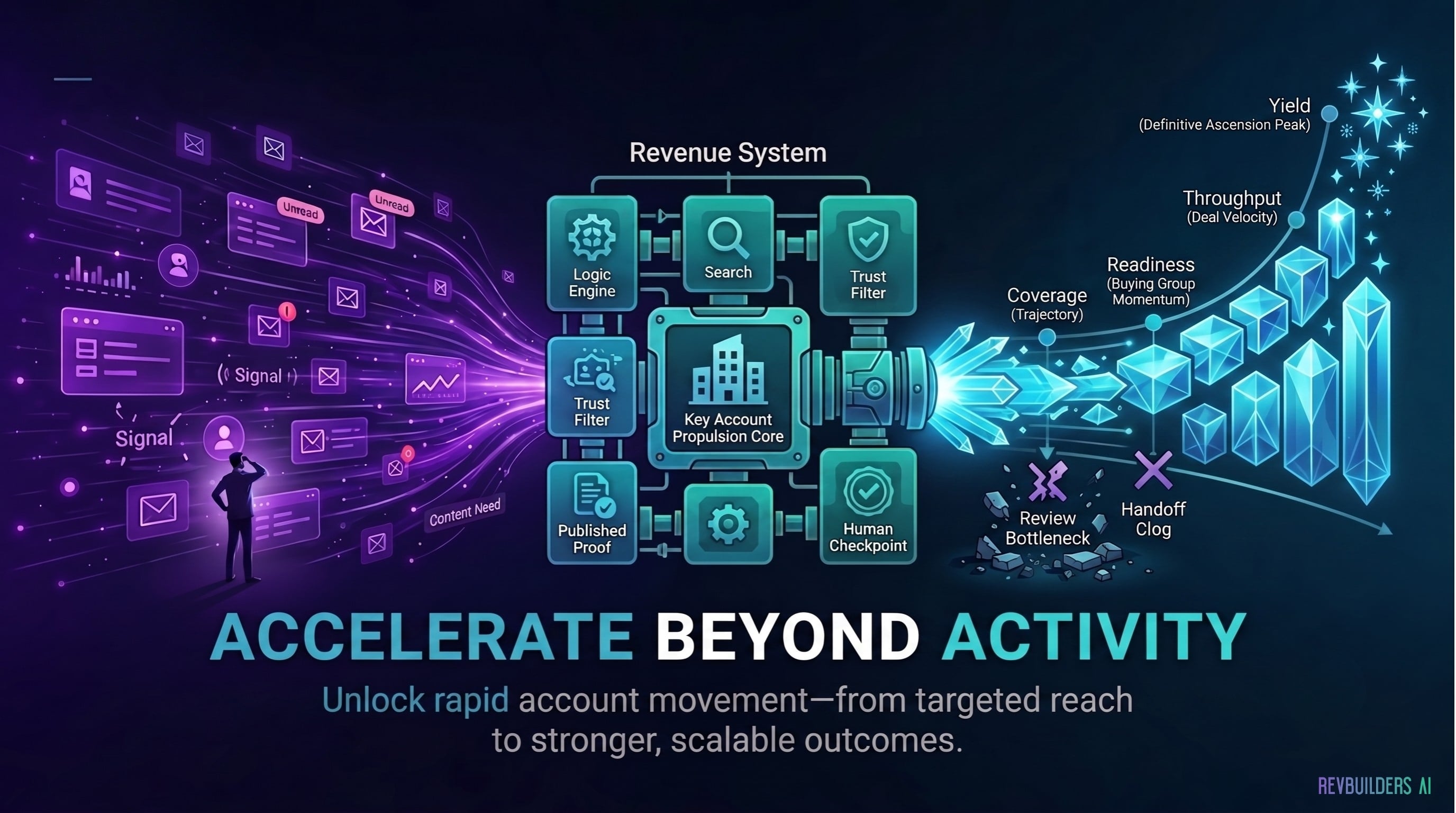
Coverage → Readiness → Throughput → Yield

To measure account-based GTM, start with the operating model, not the attribution model.

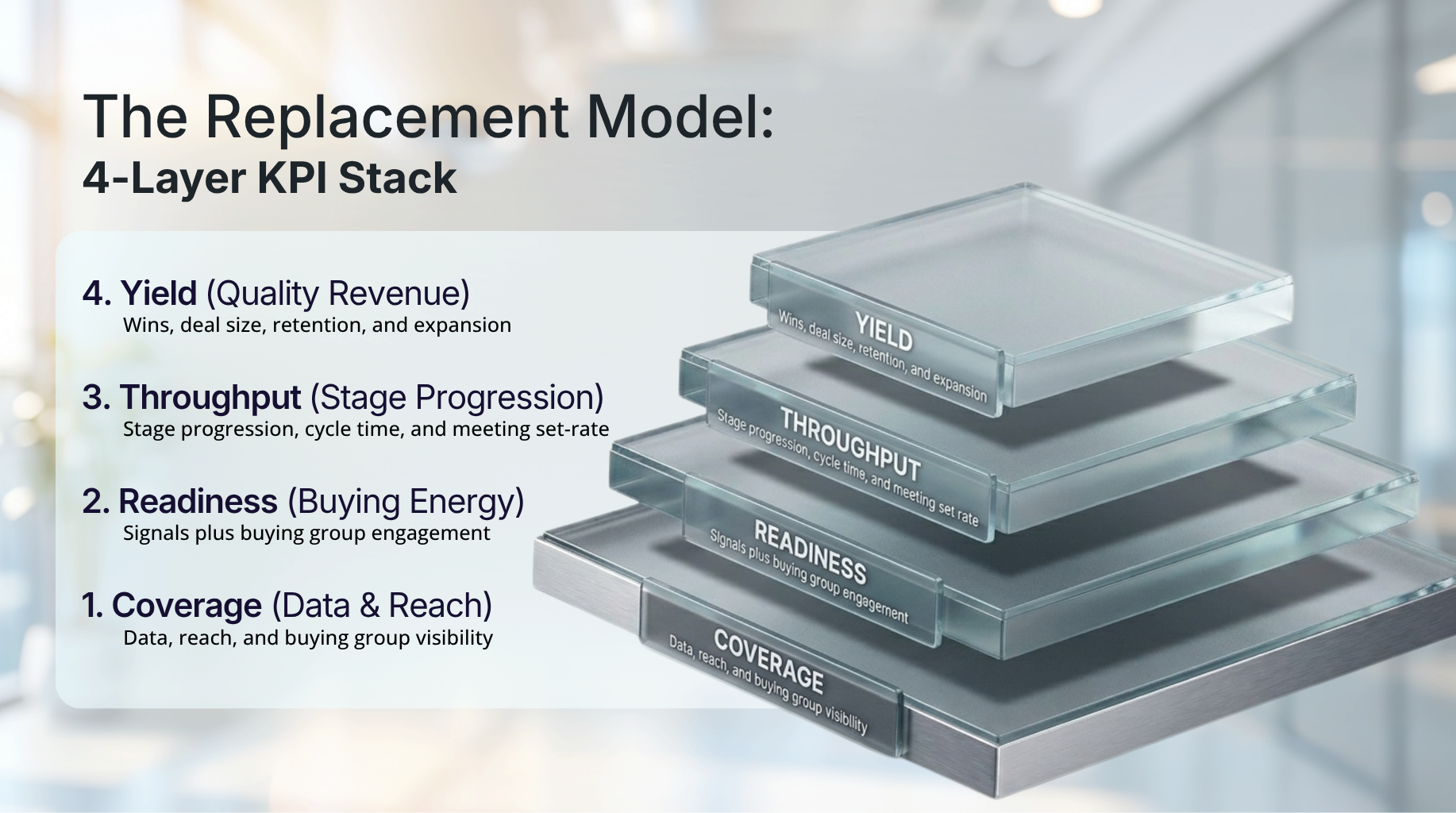
The cleanest structure is a four-layer KPI stack:

  1. Coverage: data, reach, and buying group visibility
  2. Readiness: signals plus buying group engagement
  3. Throughput: stage progression, cycle time, and meeting set rate
  4. Yield: wins, deal size, retention, and expansion

This structure gives executives, RevOps, and practitioners a shared language.

💡 It also explains why so many ABM dashboards feel busy but still unreliable: they jump to engagement or influence before the foundation is in place.

ABM-Attribution_04

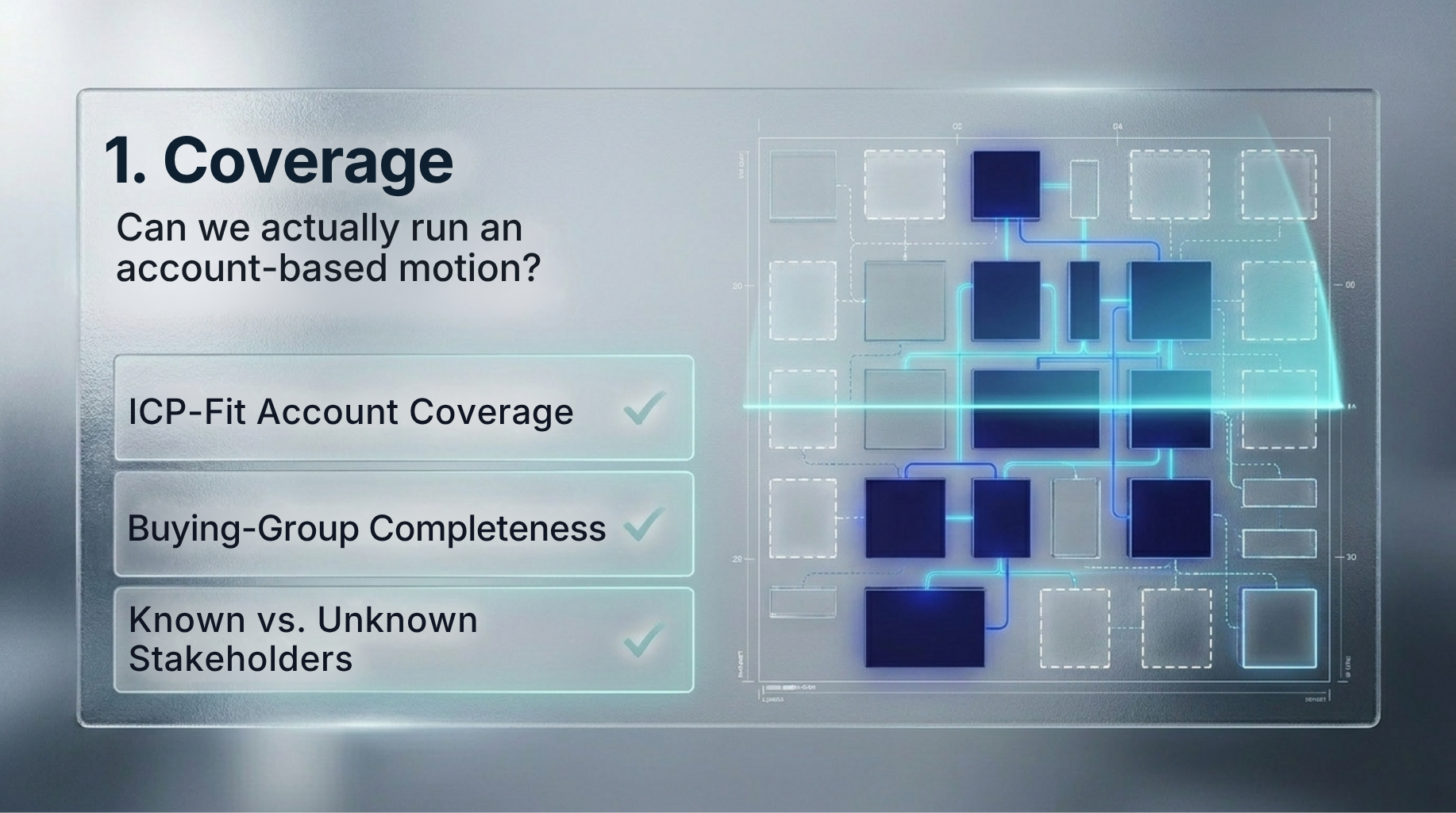
KPI Layer 1: Coverage

📏 Can we actually run an account-based motion?

Coverage answers the most basic question: do we have the right accounts, the right people, and enough reach within the buying group to run a coordinated GTM motion?

  • ICP-fit account coverage
  • Contactability by account and tier
  • Buying-group completeness
  • Role coverage across economic buyer, champion, users, technical stakeholders, security, and procurement
  • Known vs. unknown stakeholders

Coverage is the missing foundation in many ABM programs. Without it, low engagement can be misread as low intent when the real issue is poor reach. And attribution can look incomplete because much of the buying group was never visible in the first place.

ABM-Attribution_05

KPI Layer 2: Readiness

📏 Are the right people showing buying energy?

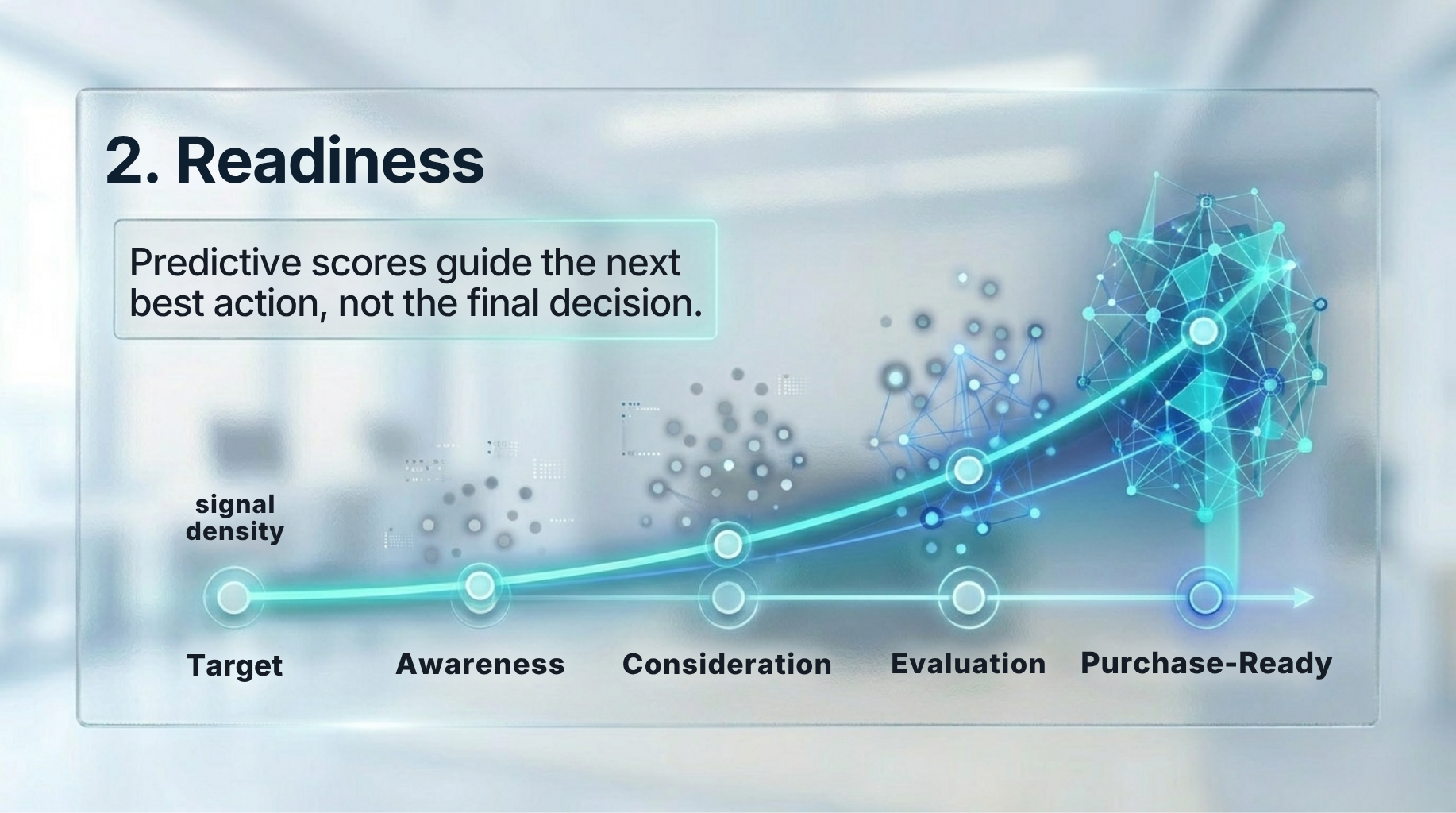
Readiness measures whether target accounts are moving through the pre-opportunity buying journey. This is where intent signals, first-party (onsite) behavior, predictive scoring, and buying-group engagement become useful, but only when interpreted at the account level.

Marketing teams often describe this journey as: TargetAwarenessConsiderationEvaluation / DecisionPurchase-Ready.

Those stages are useful because they help classify the account’s level of buying readiness. But they should not automatically trigger sales pursuit on their own. They are readiness states inside the account journey.

  • 📊 Awareness: early signs of engagement, usually low urgency
  • 📊 Consideration: increased engagement and more role diversity
  • 📊 Evaluation / Decision: high-intent topics, comparison behavior, pricing, security, proof, or business-case content
  • 📊 Purchase-Ready: strong signal density, buying-group activity, and a clear “why now”

💡 This is where predictive scoring should help. The score is not the decision. The score helps classify readiness and guide the next best action.

ABM-Attribution_06

KPI Layer 3: Throughput

📏 Are accounts progressing through the revenue ladder?

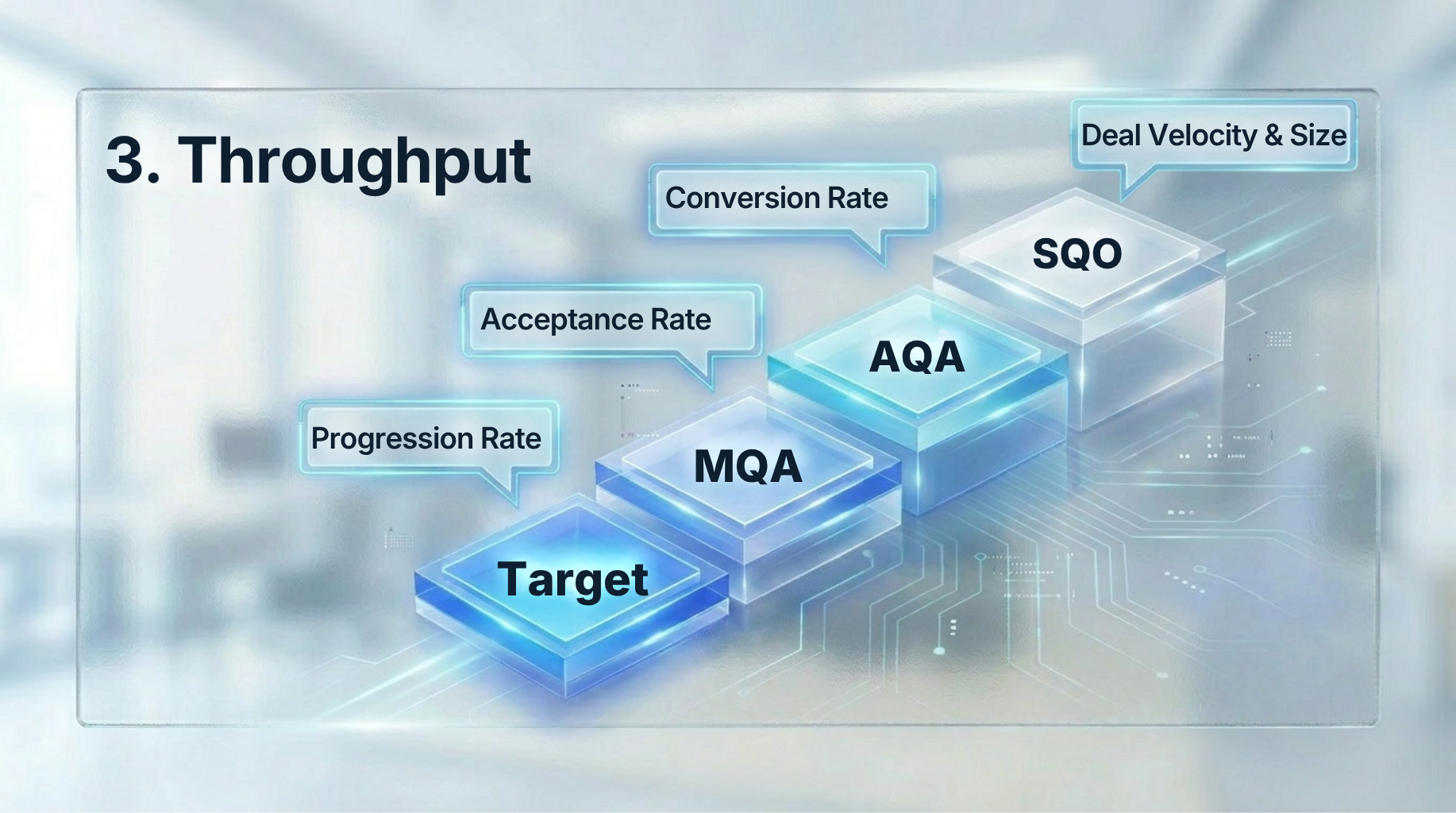
Throughput is where account-based measurement becomes operational. It answers: are target accounts moving from readiness into accepted pursuit and qualified opportunity creation?

For this campaign, the RevOps conversion ladder is:

Target → MQA → AQA → SQO.

  • 🪜 Target = ICP-fit account selected for pursuit
  • 🪜 MQAMarketing Qualified Account that crosses the readiness threshold
  • 🪜 AQA = Accepted Qualified Account, where SDRs accept the account for active pursuit
  • 🪜 SQO = Sales Qualified Opportunity, where the account becomes qualified pipeline

The bridge between Marketing stages and RevOps stages is simple:

  • Awareness, Consideration, and Decision/Evaluation are not always handoff stages. They help determine when an account is ready to become MQA.
  • Purchase-Ready becomes the MQA trigger.
  • AQA is the accepted pursuit moment.
  • SQO is the qualified opportunity milestone.

The most important throughput metrics are:

  • Account Progression Rate: the percentage of target accounts that advanced at least one stage in a time period
  • Target → MQA conversion rate
  • MQA → AQA acceptance rate
  • AQA → SQO conversion rate
  • Stage hop time
  • Meeting set rate from AQA accounts

This is also where ABM operators can move the conversation away from “who gets credit?” and toward “what moved the account?”

Attribution can still help explain influence.

But stage movement tells you whether the GTM motion is actually working.

ABM-Attribution_07

KPI Layer 4: Yield

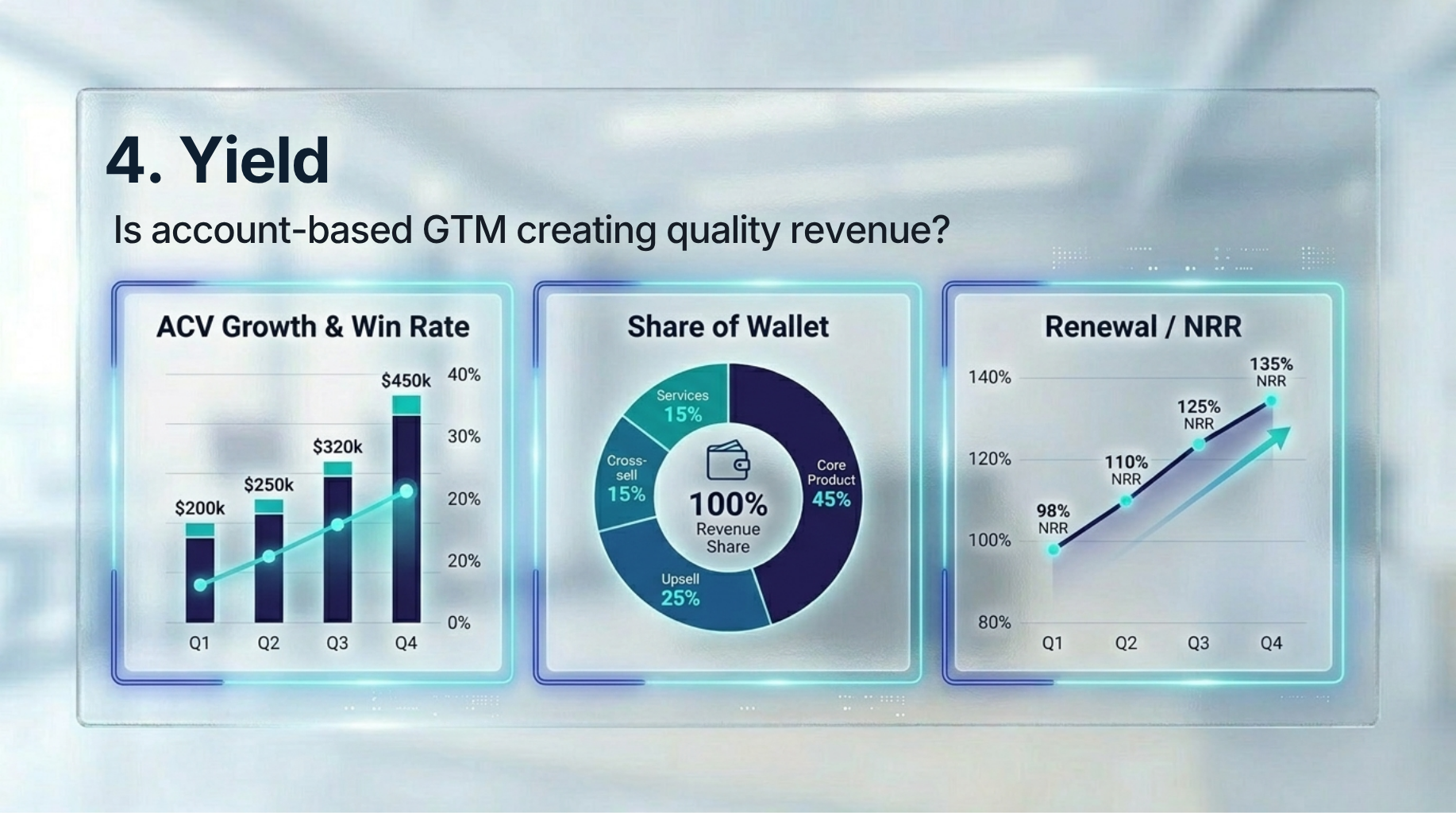
📏 Is account-based GTM creating quality revenue?

Yield connects account-based activity to business outcomes. This is where leadership can evaluate whether the account-based motion is producing the right kind of revenue, not just more activity.

  • Win rate within target accounts
  • Average contract value and deal size growth
  • Sales cycle length and stage efficiency
  • Expansion pipeline
  • Renewal rate and NRR
  • Share of wallet

💡 This is the layer where ABM moves from program performance to corporate GTM performance.

ABM-Attribution_08

Where attribution still belongs

This reset is not an argument to throw attribution away. Attribution still matters. It helps teams understand which campaigns, channels, messages, and plays contributed to movement.

The issue is when attribution is treated as the primary proof model for account-based GTM. In a buying-group reality, influence is distributed across people, channels, stages, and time. A first-touch or last-touch model can never fully explain that journey.

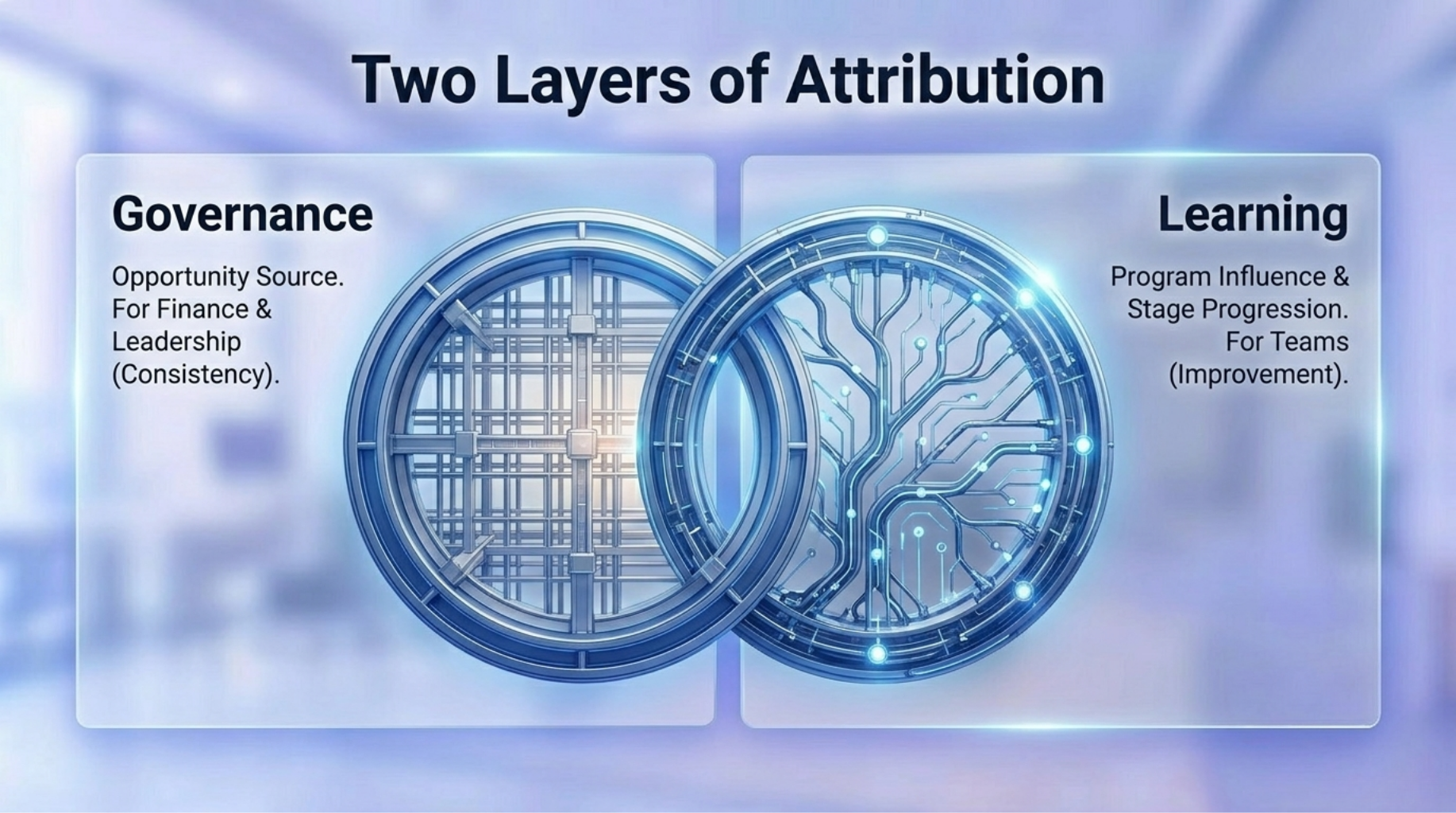
A healthier approach is to keep two layers:

  1. Governance layer: opportunity source and consistent reporting fields for finance and leadership

  2. Learning layer: program influence, role engagement, stage progression, and buying-group movement

The governance layer keeps reporting consistent. The learning layer helps the team improve the motion.

ABM-Attribution_09

CRM reality check: Salesforce vs. HubSpot

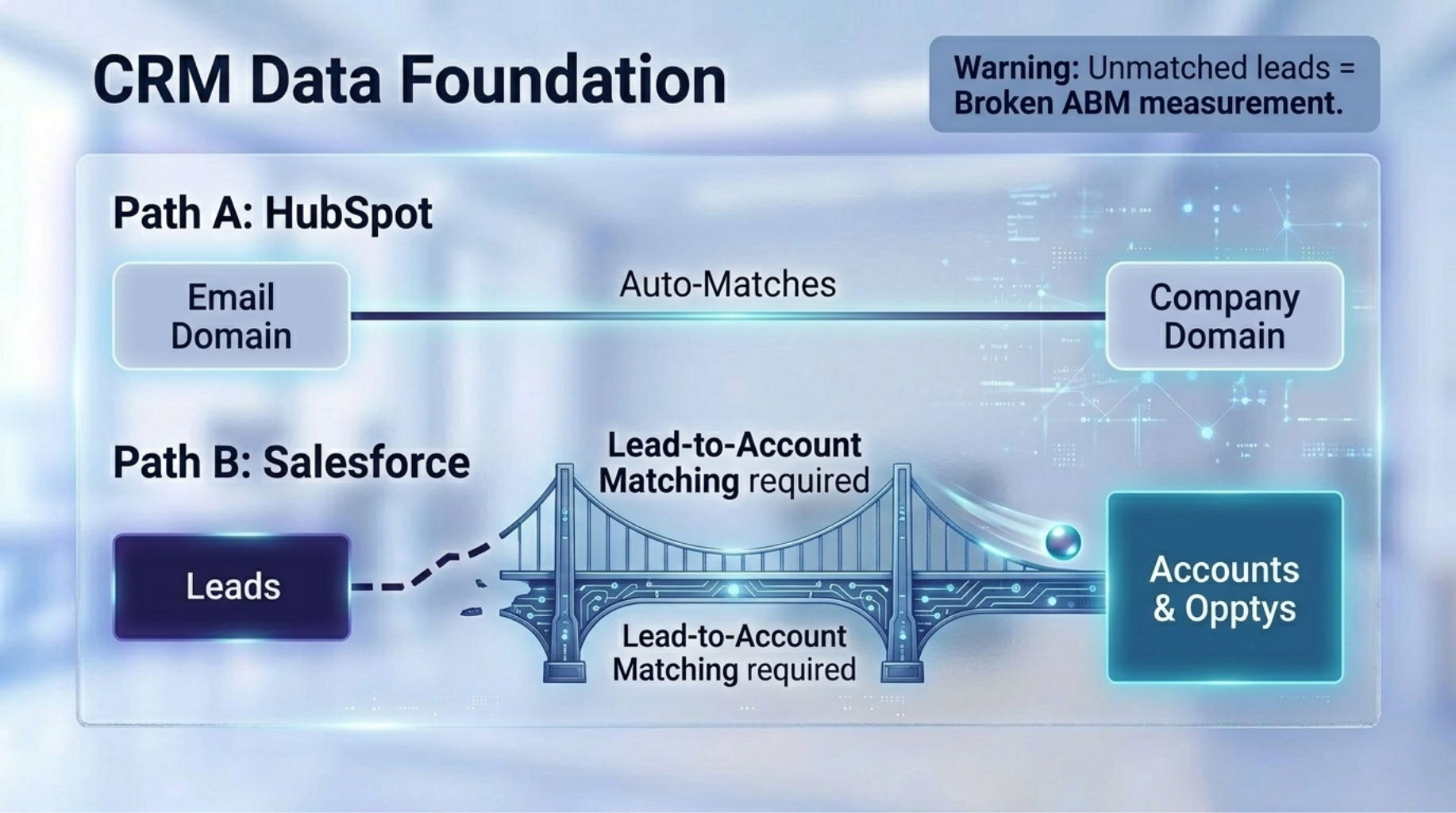
The best measurement model in the world will break if the CRM cannot roll activity and engagement up to the account.

A) HubSpot CRM: HubSpot can automatically create and associate companies with contacts by matching email domain to company domain, which makes account-level rollups easier when the data is clean. HubSpot documents this company association setting here.

B) Salesforce CRM: Salesforce uses Leads, Contacts, Accounts, and Opportunities. Lead conversion creates or connects account, contact, and opportunity records. Salesforce Trailhead explains the lead conversion process here. For ABM, that means lead-to-account matching is critical if pre-opportunity activity is happening on leads that are not yet connected to accounts.

When Salesforce leads are not matched to accounts, account engagement, account penetration, attribution, and progression reporting will be incomplete. This is not a minor ops detail. It is the data foundation for ABM measurement.

ABM-Attribution_10

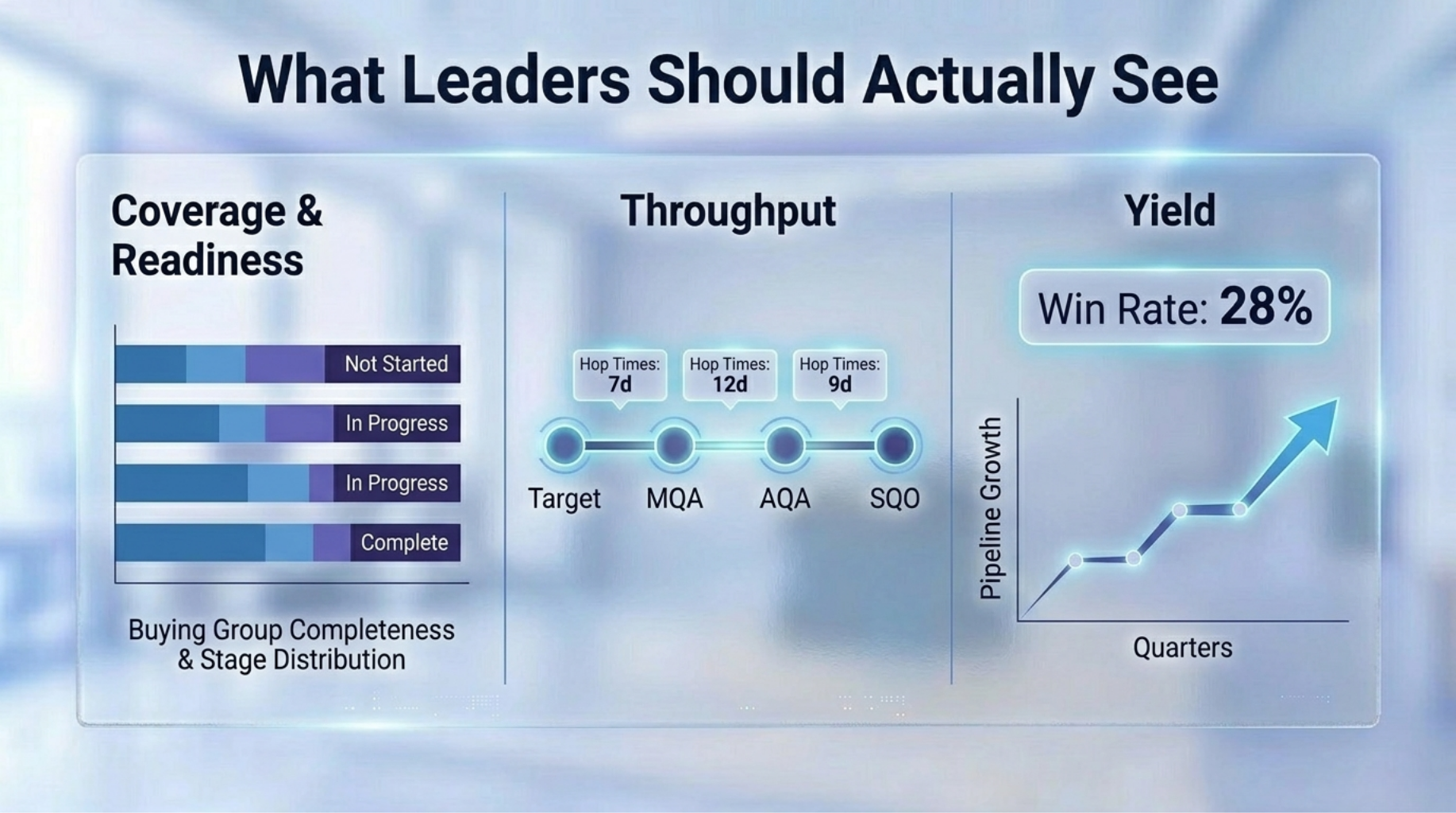
What leaders should see in an ABM dashboard

A leadership dashboard should not be a campaign recap. It should show whether the account-based GTM motion is working.

A clean executive view should include:

  1. Target account coverage by tier and segment
  2. Buying-group completeness by tier
  3. Engaged roles and readiness stage distribution
  4. Target → MQA conversion
  5. MQA → AQA acceptance
  6. AQA → SQO conversion
  7. Median hop time by stage
  8. Meeting set rate
  9. SQO and pipeline from target accounts
  10. Win rate, ACV, retention, and expansion outcomes

The point is not to create more dashboards. The point is to create one shared view that tells leaders where account movement is happening, where it is stalling, and what needs to change.

ABM-Attribution_12

What to fix first

If your team is still being asked to defend account-based programs with lead-era metrics, do not start by debating attribution models. Start with the operating model.

  1. Define the account-based KPI stack: Coverage, Readiness, Throughput, Yield.
  2. Map pre-opp marketing journey stages to:
    Target → Awareness → Consideration → Evaluation/Decision→ Purchase-Ready.
  3. Align those targets to the RevOps ladder:
    Target → MQA → AQA → SQO.
    And set the MQA and AQA criteria with Sales and RevOps.
  4. Audit CRM account association, and lead-to-account matching in Salesforce.
  5. Build one leadership dashboard around account progression.
  6. Use attribution as a diagnostic layer, not the only proof of impact.

Bottom line

The problem is not attribution.

The problem is using lead-era metrics to measure account-based GTM.

ABM only works when it is part of the broader GTM strategy, not a marketing side project.

That means success has to be measured through buying-group coverage, readiness, stage progression, and revenue yield.

Stop asking account-based programs to prove themselves with a lead-era campaign scorecard. Measure the motion the way it actually creates revenue.

Over to you

Join the live discussion: ABM Metrics & Attribution in 2026: Pipeline Momentum, Not Vanity Metrics, Thursday, May 7 webinar with RevAI Real Talk™ and LuckBoosters.
👉 Register for the Webinar

Download the ABM GTM Measurement Reset Kit to replace lead-era campaign reporting with an account-based measurement model your RevOps, GTM, and leadership teams can trust.

Stay in the conversation: Subscribe to RevAI Real Talk™ and submit your ABM attribution question for a future deep dive.

ABM-Attribution_13


Source links referenced


Share this post