

9 min read

AI Reads Your Emails First: The New Rules of B2B Outreach

AI Reads Your Emails First: The New Rules of B2B Outreach
16:40

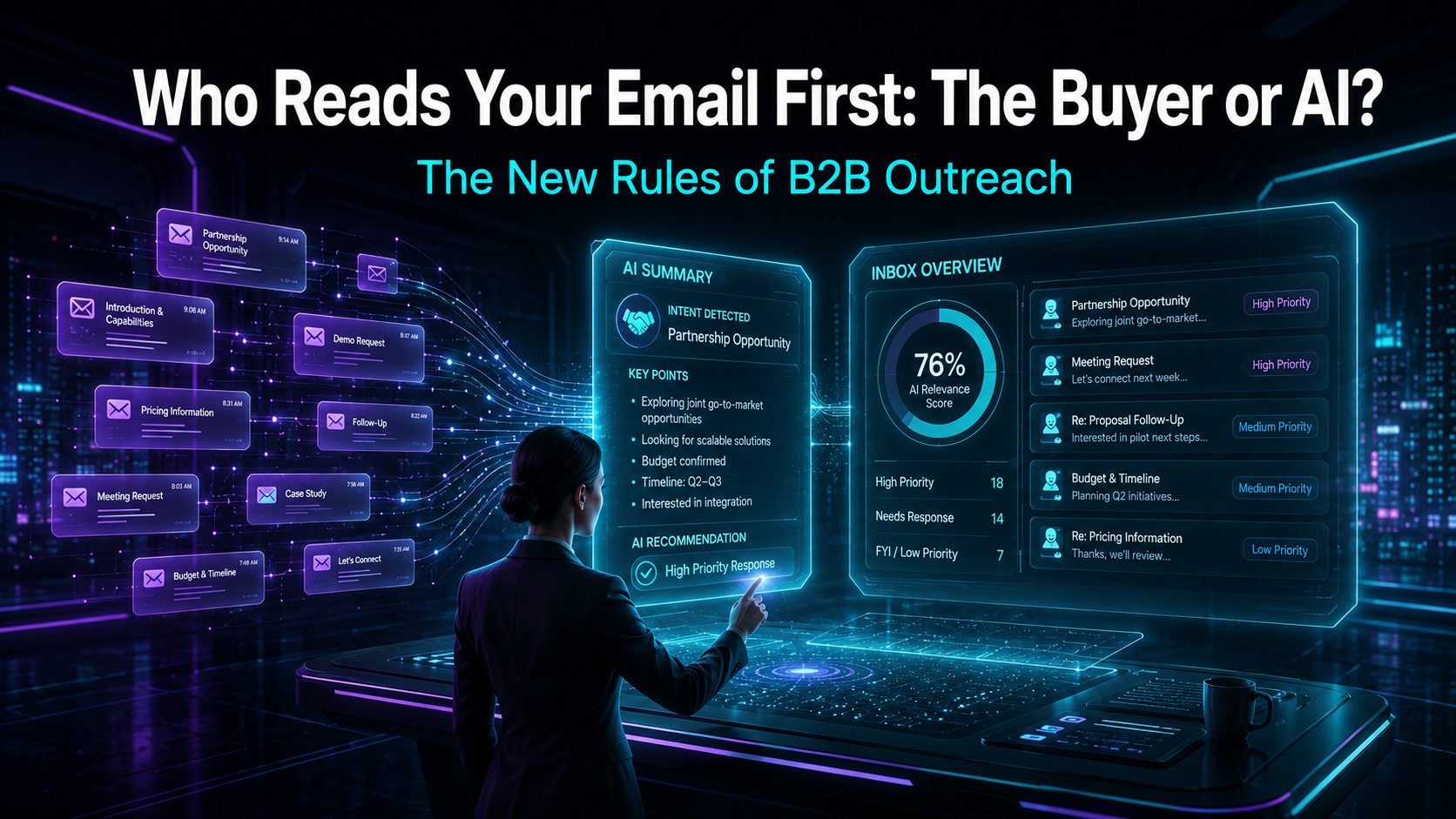
Who reads your email first — the buyer or AI?

That question sounds staged until you look at what is already happening inside modern enterprise inboxes.

Microsoft Copilot in Outlook can summarize long email threads. Google’s Gemini in Gmail can summarize lengthy email conversations and surface key points before the recipient reads every message. In other words, the first version of your outreach a buyer sees may not be your subject line, your preview text, or your carefully written opening paragraph. It may be the inbox’s compressed interpretation of what you meant.

That changes the job of B2B outreach.

For years, GTM teams optimized email around familiar levers: subject lines, send times, open rates, sequence steps, reply rates, and personalization tokens. Those things still matter. But they are no longer enough.

Because in an AI-mediated inbox, the question is not only:

The old question

Did the email get delivered?


It is also:

The new question

Did the inbox understand the value clearly enough to preserve it?


That is the real shift. AI inbox summaries do not just create a new email tactic. They expose a deeper GTM problem: too many outreach messages are still built around activity, not market understanding.

The inbox is becoming an interpretation layer

Classic email deliverability was largely about access.

Can your message get authenticated?

Can it avoid spam filtering?

Can it land in the primary inbox?

Can it avoid triggering complaints?

Those fundamentals are still table stakes. SPF, DKIM, DMARC, sender reputation, complaint rates, list quality, and engagement signals still matter.

But AI inbox summaries introduce a new layer.

Today’s inbox experience increasingly looks like this:

  • Sender reputation and authentication — Are you allowed in?
  • Inbox filtering and priority routing — Where does the message land?
  • AI summarization and meaning extraction — What does the inbox think the message says?
  • Human attention — Does the buyer decide it is worth reading?

Most B2B teams are still focused on the first two layers. The pressure is now moving to layer three.

Email strategist Chad S. White has described AI summaries and content extraction as part of a new era of email deliverability — one where inbox providers are changing how senders’ messages are interpreted, surfaced, and experienced.

That means “delivered” is no longer the finish line.

An email can technically land in the inbox and still lose because the AI-generated summary makes it sound generic, low-value, or irrelevant.


This is not just an email problem. It is a GTM clarity problem.

AI inbox summaries create a brutal filter for vague outreach.

If your email says:

We help organizations streamline operations and improve efficiency.


The summary will probably sound like:

Vendor wants to discuss operational efficiency.


That is not wrong. It is just not useful.

And that is the problem.

AI summaries tend to flatten generic language because there is nothing specific to preserve. If the message does not clearly state who it is for, what problem it addresses, and why it matters now, the summary will often reduce it to a bland vendor note.

The stronger your message architecture, the better chance your intent survives compression.

The weaker your message architecture, the more likely your email becomes just another “checking in” message in a crowded inbox.


The AI-safe outreach pattern: role + problem + useful next step

The goal is not to “trick” AI inboxes.

The goal is to write outreach that is clear enough for both machines and humans to understand.

AI-safe pattern

Role + specific problem + useful next step


That pattern forces the message to answer three questions quickly:

  • Who is this relevant to?
  • What real business issue does it connect to?
  • What is the next step that feels useful rather than performative?

That is especially important in ABX and account-based GTM, where outreach is rarely about one individual. It is about a buying group trying to make sense of timing, risk, budget, process, and internal alignment.


Example: public-sector procurement outreach

Public-sector procurement is a great example because vague vendor language gets flattened fast.

Procurement professionals are not looking for another “modernization” pitch. They are often dealing with specific pressures: RFP scoring defensibility, audit readiness, supplier compliance, public records requests, contract cycle time, vendor onboarding, cooperative purchasing decisions, and protest risk.

Weak version

Subject: Improving procurement efficiency

Hi ,
We help public-sector teams streamline procurement workflows and improve sourcing outcomes. Would you be open to a quick conversation about how we can support your goals this year?


Likely AI inbox summary:

Vendor wants to discuss procurement efficiency.


That summary is technically accurate. But it does nothing to earn attention.

AI-safe version

Subject: RFP scoring clarity

For public-sector procurement teams, unclear evaluation criteria can slow awards and increase protest risk.

We built a 1-page RFP scoring checklist to help teams make scoring easier to defend without adding more review cycles. Want me to send it?


Likely AI inbox summary:

Offers a 1-page RFP scoring checklist to help reduce protest risk and make scoring more defensible.


That second summary has a much better chance of surviving the inbox filter because the value is specific.

  • It names the audience.
  • It names the problem.
  • It names the useful next step.

No buzzwords. No inflated claim. No “quick chat?” as the entire point.


The same pattern works in commercial finance

This is not limited to public sector outreach.

For commercial finance leaders in 2026, vague “cut costs” messaging is just as easy to ignore. Budget pressure is real, but finance teams are not just looking for cheaper tools. They are evaluating payback windows, vendor consolidation, risk reduction, working-capital impact, and whether a purchase fits the operating plan.

Weak version

Subject: Reduce software costs

Hi ,
We help finance teams reduce costs and improve efficiency across their tech stack. Are you open to a quick call?


Likely AI inbox summary:

Vendor wants to discuss reducing software costs.


AI-safe version

Subject: 2026 vendor spend review

For finance teams reviewing 2026 spend, the hard part is not “cutting costs.” It is knowing which tools have a clear payback window, reduce risk, and simplify vendor sprawl.

We put together a vendor consolidation checklist finance teams can use before renewal season. Want it?


Likely AI inbox summary:

Shares a vendor consolidation checklist for finance teams reviewing 2026 spend, payback, risk, and tool sprawl.


Same structure. Different audience. Better interpretation.


Cadence is becoming a reputation signal

The other big shift is cadence.

A lot of GTM teams still think about cadence as coverage:

  • How many touches?
  • How many days apart?
  • How many channels?
  • How many personas?
  • How many accounts?

But in an AI-mediated inbox, cadence is not just a schedule. It is a reputation signal.

Repeated low-value messages do not just train humans to ignore you. They may also train the inbox experience to treat your messages as low-priority, skimmable, or not worth surfacing.

That means the question changes from:

Old cadence question

How often should we send?


to:

Better GTM question

What signal makes this worth sending now?


That is a much healthier GTM question.

For ABX teams, this should push outreach closer to account reality:

  • Did something change at the account?
  • Is there a relevant trigger?
  • Is a stakeholder showing intent?
  • Is there a known initiative, renewal, regulation, budget event, or operational constraint?
  • Does this message help the buying group move forward?

If the answer is no, silence may be the better GTM decision.

That will feel uncomfortable for teams measured on activity volume. But the future of B2B outreach is not more touches. It is better-timed relevance.


Opens are getting noisier. Buyer movement matters more.

Open rates have been a shaky metric for years. AI inbox summaries make them even less complete as a measure of real engagement.

An email may be summarized before it is opened.

A buyer may get the gist without clicking.

A message may influence internal discussion without producing a clean open-to-click trail.

That does not mean email metrics are useless. It means they need to be put in context.

Revenue teams should spend less time asking:

Narrow question

Did the email perform?


And more time asking:

Better question

Did the outreach move the account or buying group forward?


Better indicators include:

  • Reply quality
  • Meetings held, not just booked
  • Stakeholder engagement across the account
  • Account progression
  • Pipeline created
  • Pipeline advanced
  • Time-to-next-step
  • Sales conversation quality
  • Buying-group expansion

This is where RevOps, Marketing, SDR leadership, and Sales need a shared scoreboard.

If Marketing only sees sends, opens, and clicks — while Sales only sees meetings and opportunities — nobody has the full picture. The more AI mediates the buyer experience, the more important it becomes to measure the whole GTM motion, not isolated campaign activity.


What GTM leaders should change first

This does not require a massive transformation project.

Start with the part of outreach most likely to be summarized: the opening.

Pull 10–20 recent outbound or lifecycle emails and pressure-test them with three questions:

  • Would an AI summary know who this message is for?
  • Would it preserve the actual business problem?
  • Would the next step sound useful, or just like a meeting request?

Then look for the pattern.

If most messages summarize as “vendor wants to connect,” the problem is not the AI. The problem is the message.

The fix usually starts with three moves:

1. Make the first two lines carry the meaning

Do not use the opening as a polite runway. Use it to establish relevance.

Weak opening:

Hope you’re doing well. I wanted to reach out because we work with teams like yours.


Stronger opening:

For public-sector procurement teams, unclear RFP scoring criteria can create delays, protest risk, and extra review cycles.


That one sentence gives the inbox and the buyer something real to work with.


2. Keep one email to one idea

Multi-topic emails are summary killers.

If your message includes a product update, a webinar invitation, a customer proof point, a meeting ask, and a “just checking in,” the likely summary becomes mush.

One email. One audience. One problem. One next step.


3. Replace generic value with concrete usefulness

“Improve efficiency” is not enough.

Try naming the actual artifact, question, decision, or risk:

  • RFP scoring checklist
  • Audit-trail readiness template
  • Vendor onboarding packet outline
  • Cooperative purchasing decision tree
  • Renewal risk worksheet
  • Payback-window calculator
  • Budget-fit checklist

Concrete value survives summarization better than broad positioning.


Use AI as your writing partner, not your volume engine

The irony is that AI can help solve the very problem AI inbox summaries create.

Not by generating more email.

By helping teams pressure-test clarity before the message goes out.

Here is a practical prompt you can use with your own AI tool.

Copy/Paste Prompt:

Rewrite Outreach for AI Inbox Summaries

Act as my B2B revenue marketing and ABX writing partner. Rewrite the outreach email below so it remains clear and compelling after AI inbox summarization.

Target audience: [ICP + role]
Buyer problem: [specific business problem]
Offer / reason for outreach: [what I am sending]
Proof / context: [one proof point or insight]
CTA: [one simple action]

Constraints:
Keep the body under 120 words. Use one idea only. No buzzwords. Use concrete language. Make the first two lines carry the meaning.

Output:
1. 5 short subject lines
2. One direct version
3. One warmer version
4. A likely AI inbox summary for each
5. One sentence explaining why the message will summarize well

Draft email to improve:
[paste email here]


The bigger GTM takeaway

AI inbox summaries are not just an email feature.

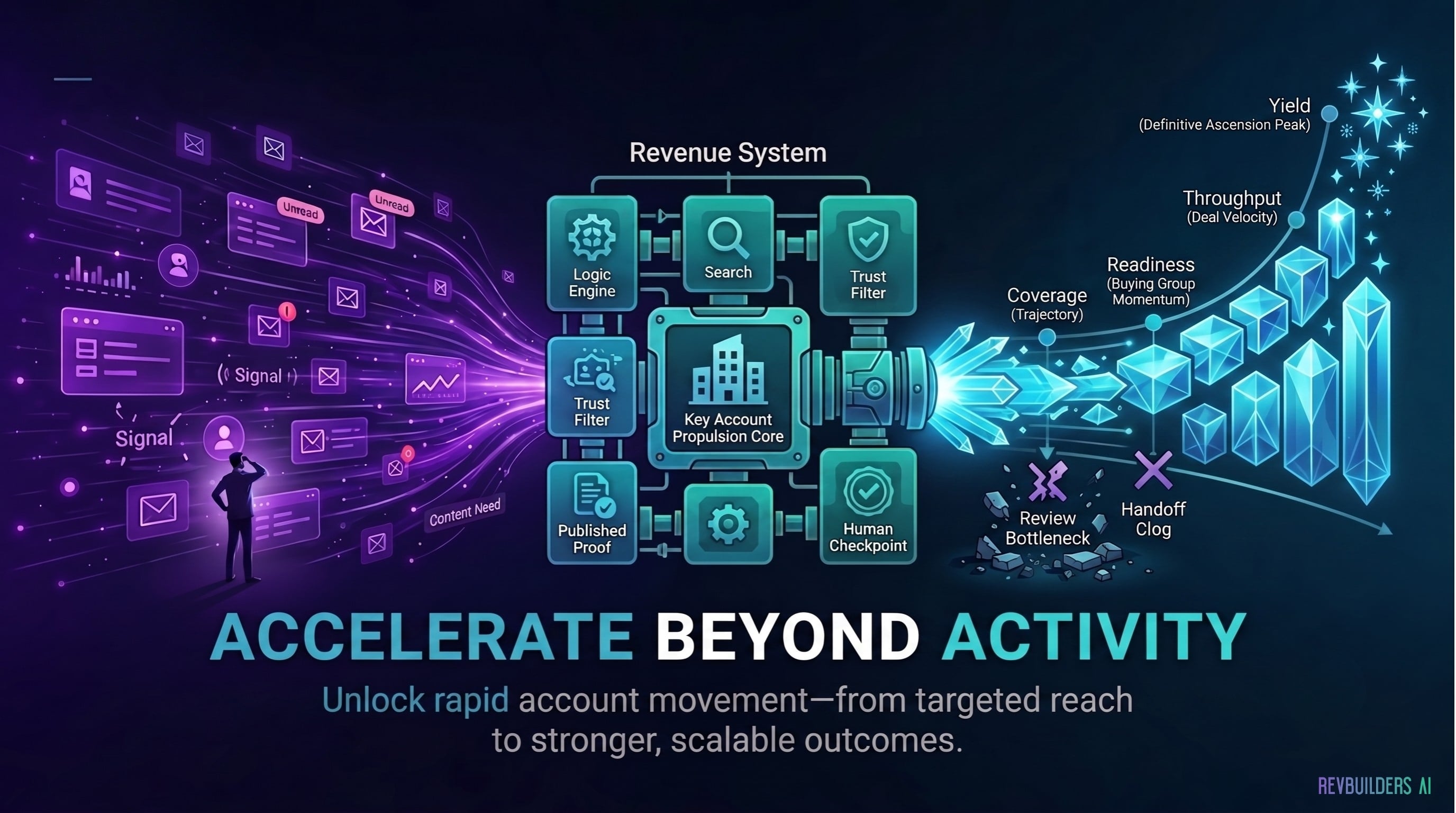
They are another signal that B2B GTM is moving away from activity-based execution and toward signal-based orchestration.

The teams that adapt fastest will not be the ones sending the most email. They will be the ones who understand the market well enough to know:

  • who needs the message,
  • why now,
  • what problem matters,
  • what proof builds trust,
  • what next step helps the buying group move.

That is the real shift.

Marketing cannot just be “market-ing” — launching, sending, posting, promoting, chasing activity.

Modern GTM has to get closer to the actual market: buyer needs, account signals, role-specific friction, decision timing, and measurable movement.

The inbox is forcing the discipline.

If your email gets summarized before your buyer reads it, your message has to survive interpretation.

That means clearer language. Sharper context. Better timing. More useful next steps. And a scoreboard focused on buyer movement, not just email activity.


RevAI Real Talk™ Newsletter

Keep sharpening the signal

If this AI-safe outreach lens is useful, subscribe to RevAI Real Talk™ for practical frameworks, prompts, and operator-led guidance on modernizing B2B GTM in the AI era — from clearer messaging and buyer signals to smarter ABX execution.

Link: https://www.revbuilders.ai/real-talk


Revenue AI Accelerator™ Masterclass

Ready to operationalize buyer signal into GTM execution?

If your team is ready to move beyond email activity and start building a signal-driven revenue motion, the Revenue AI Accelerator™ Masterclass walks you through how to design and operationalize Revenue AI across your GTM system — from data foundations and governance to AI-assisted plays that turn buyer signals into pipeline movement.

Link: https://www.revbuilders.ai/revenue-ai-accelerator


Watch the episode

Scheduled for release May 23, 2026

In Episode 004 of RevAI Real Talk™, we break down how AI inbox summaries are changing B2B outreach, why this matters for ABX and revenue marketing, and how to write emails that stay clear even when the inbox compresses them first.

Link: https://www.youtube.com/@RevAIRealTalk

CTA

Grab the AI-Resilient Emails — A B2B GTM Guide for the rewrite framework, prompt workflow, and examples you can adapt with your team. [Add guide link when published]


FAQ Section for SEO / AEO


What are AI inbox summaries?

AI inbox summaries are AI-generated overviews of email threads or messages. Tools like Microsoft Copilot in Outlook and Gemini in Gmail can summarize long email conversations so recipients can quickly understand key points without reading every message in full.

How do AI inbox summaries affect B2B outreach?

AI inbox summaries can change the first impression of an outreach email. Instead of seeing the full message first, a buyer may see a compressed summary generated by the inbox. If the original email is vague, the summary may make it sound generic or low-value.

What is AI-safe outreach?

AI-safe outreach is B2B email written clearly enough to survive AI summarization. It usually includes a specific audience, a concrete business problem, one useful next step, and language that avoids vague marketing claims.

Do subject lines still matter?

Yes, subject lines still matter. But they are no longer the only first impression. In AI-enabled inboxes, the summary of the message may become just as important as the subject line or preview text.

What metrics should B2B teams track beyond open rates?

B2B teams should track buyer movement: reply quality, meetings held, stakeholder engagement, account progression, pipeline created, pipeline advanced, and time-to-next-step. Opens and clicks still provide context, but they should not be the only measure of outreach performance.


Embedded Source Links

The following source links are embedded inline in the draft above:

AI Reads Your Emails First: The New Rules of B2B Outreach

AI Reads Your Emails First: The New Rules of B2B Outreach

Who reads your email first — the buyer or AI?

Read More
How To Choose A Revenue AI Program In 2026

How To Choose A Revenue AI Program In 2026

Choosing the right Revenue AI program in 2026 isn't about chasing the newest tool — it's about finding a system that turns buyer signals into...

Read More
GTM Metrics & Attribution: Stop Measuring ABM with Lead-Era Metrics

GTM Metrics & Attribution: Stop Measuring ABM with Lead-Era Metrics

Why ABM is a corporate GTM strategy – not a marketing campaign – and how to replace lead-era reporting with account-based measurement across...

Read More