 Nikke Rose
Signal-Driven GTM: When Everyone Has Signals, Context Differentiates
 Nikke Rose: 25 Aug 2026
LinkedIn just gave GTM teams a signal of its own.




Build the foundation AI GTM needs to produce measurable revenue outcomes.
→ Start with your greatest confidence gap, then follow the right path from clarity to measurable activation and scale.
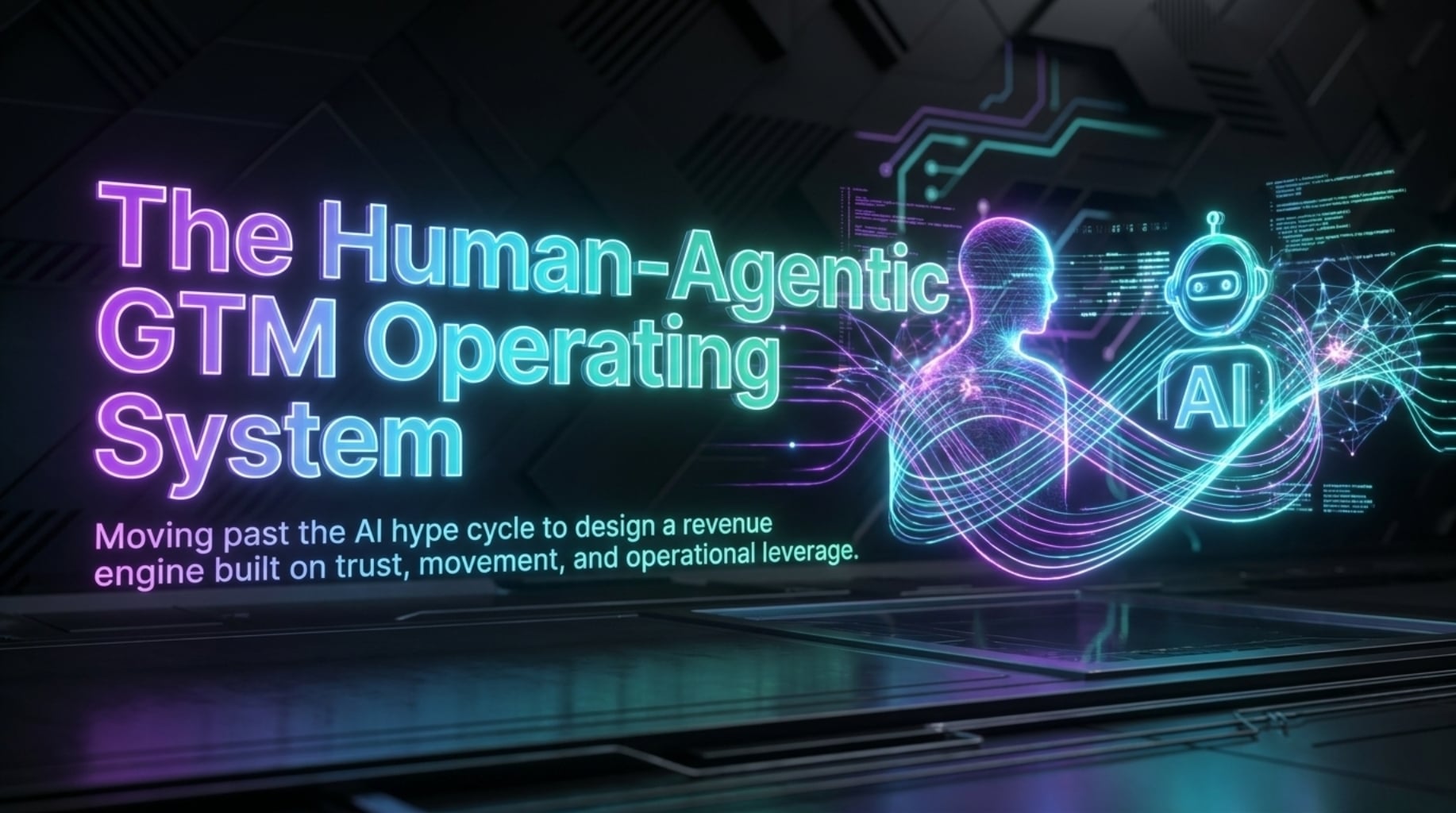
Over the past month, I went deep into designing a human-agentic GTM operating model for an enterprise SaaS firm. And on a single slide, I mapped what humans should own, what agents should accelerate, which systems need to connect the work, where governance belongs, and how the business should measure whether the model is actually working.
The further I went down that rabbit hole, the clearer the real issue became:
This is not primarily an AI tooling conversation.
It is a work-design conversation.
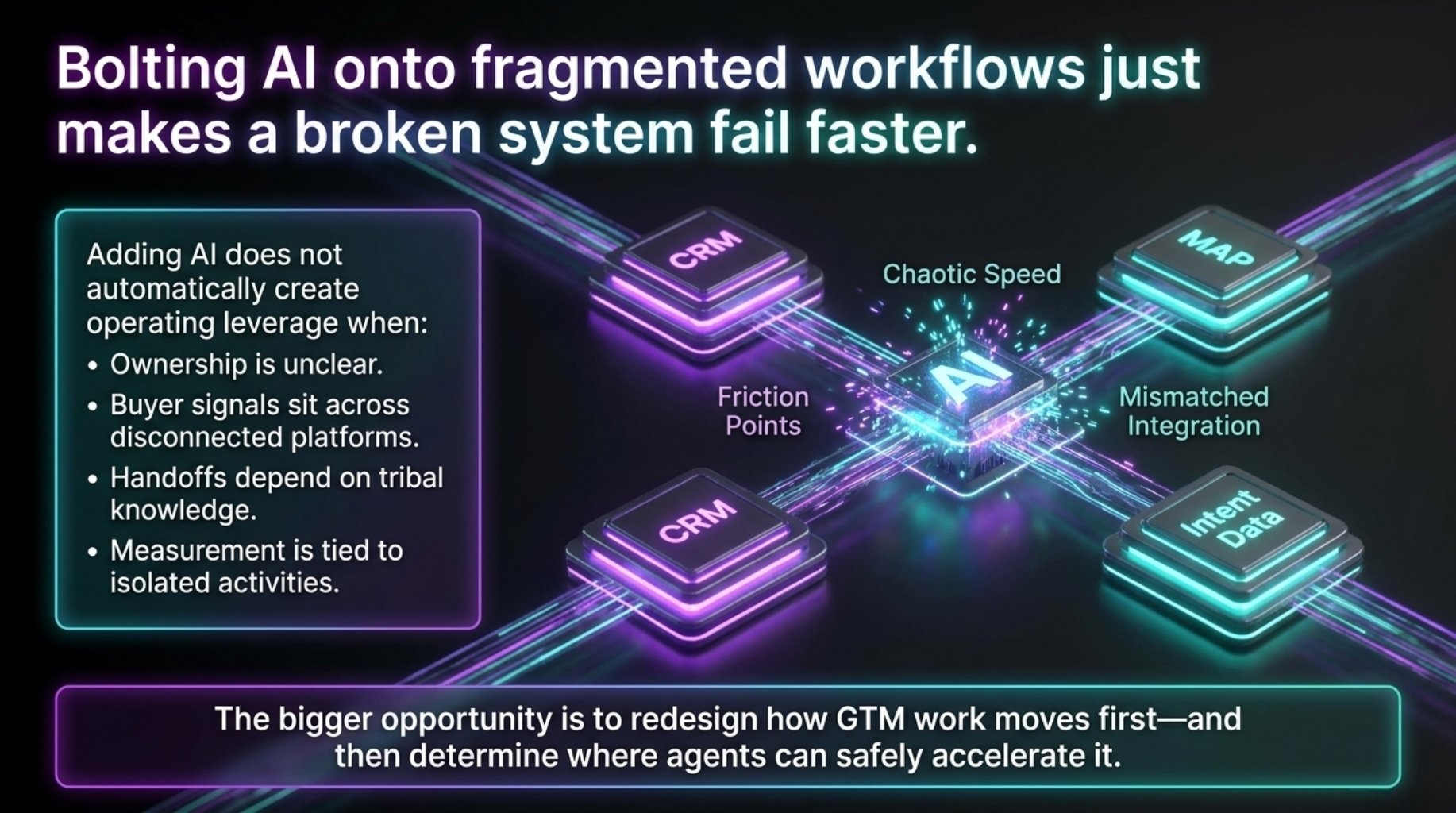
Because when workflows are fragmented, ownership is unclear, buyer signals sit across disconnected platforms, handoffs depend on tribal knowledge, and measurement is still tied to isolated activity, adding AI does not automatically create operating leverage.
It can simply make a fragmented system move faster.
The bigger opportunity is to redesign how GTM work moves first — and then determine where agents can safely and meaningfully accelerate it.
That is where human-agentic GTM begins.
And that is what inspired this breakdown: the operating logic behind the one-slide model, and what it reveals about the future of human-agentic GTM.
Human-agentic GTM is a revenue operating model where humans own strategic judgment, priorities, approvals, and accountability, while AI agents accelerate repeatable execution across research, drafting, briefing, orchestration, handoff preparation, and measurement.
The model rests on five connected ideas:
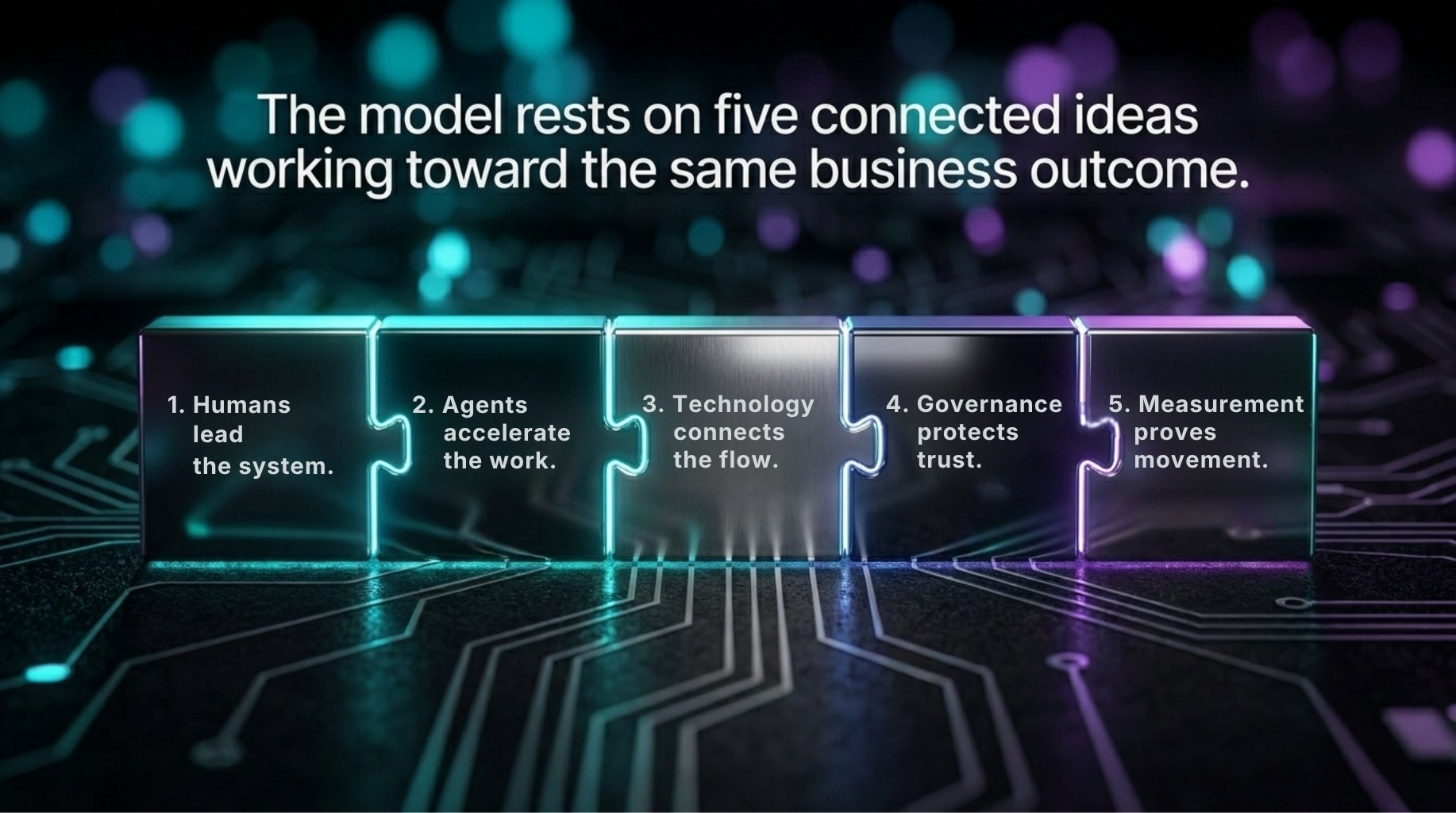
This is a very different starting point from asking, “Which AI tools should we buy?” or “How many agents should we deploy?”
The better question is:
"How should the revenue engine be designed so people, agents, systems, and signals work together toward the same business outcome?"
That is the shift.
Not AI as a productivity layer sitting on top of the same old GTM motion.
AI as part of a better-designed operating system.
B2B buying has changed.
Buyers are more self-directed. AI is already shaping discovery and evaluation. Buying groups are larger and harder to see. Revenue teams are trying to make sense of signals across CRM, MAP, intent platforms, web behavior, sales engagement tools, content systems, and dashboards.
And yet, many GTM motions are still designed around isolated activities:
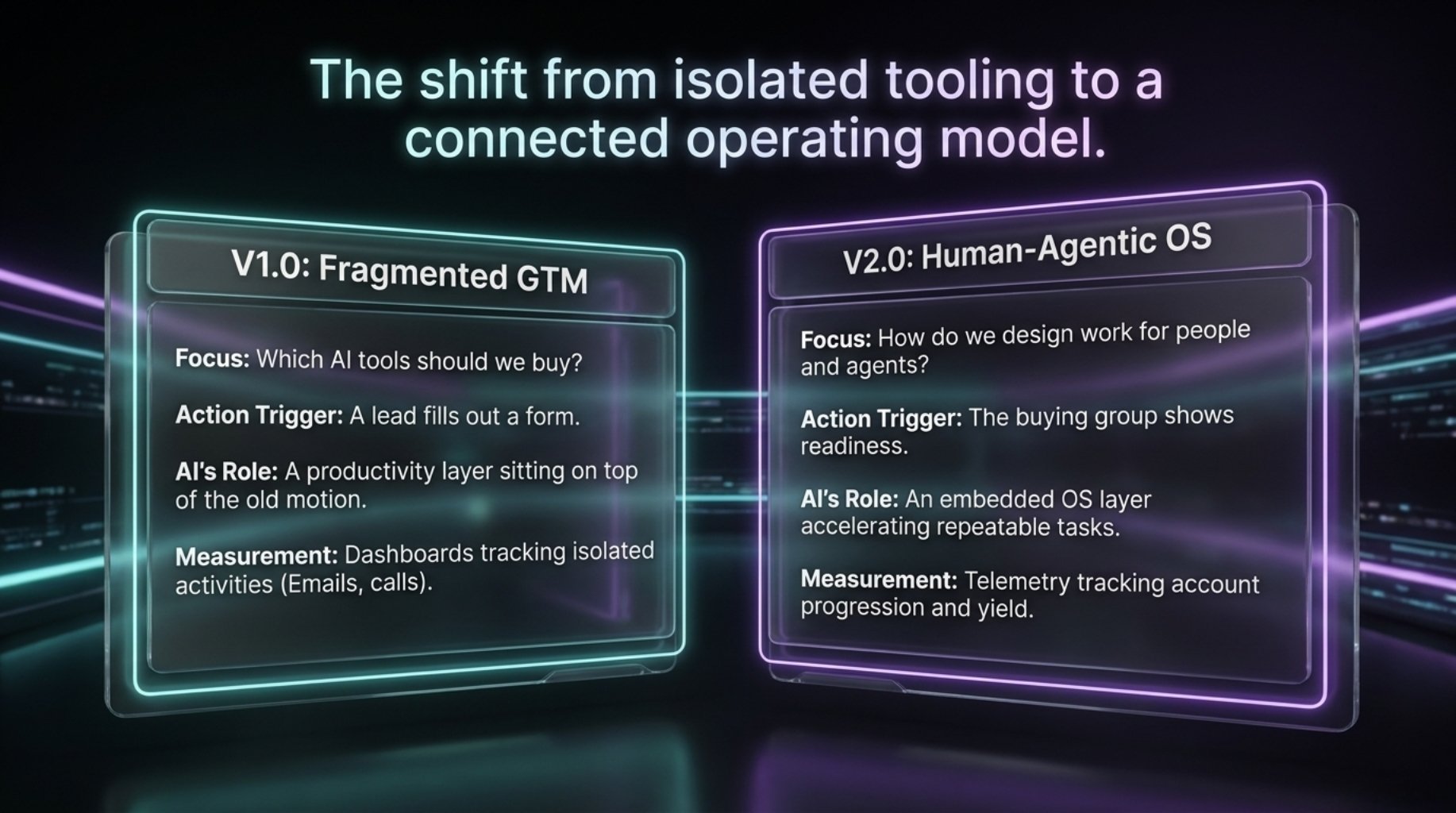
This is exactly where human-agentic GTM gets interesting.
Not because agents replace people.
But because agents can reduce the manual drag between the moments where humans need to make better decisions.
The operating model I worked through has three sub-models:
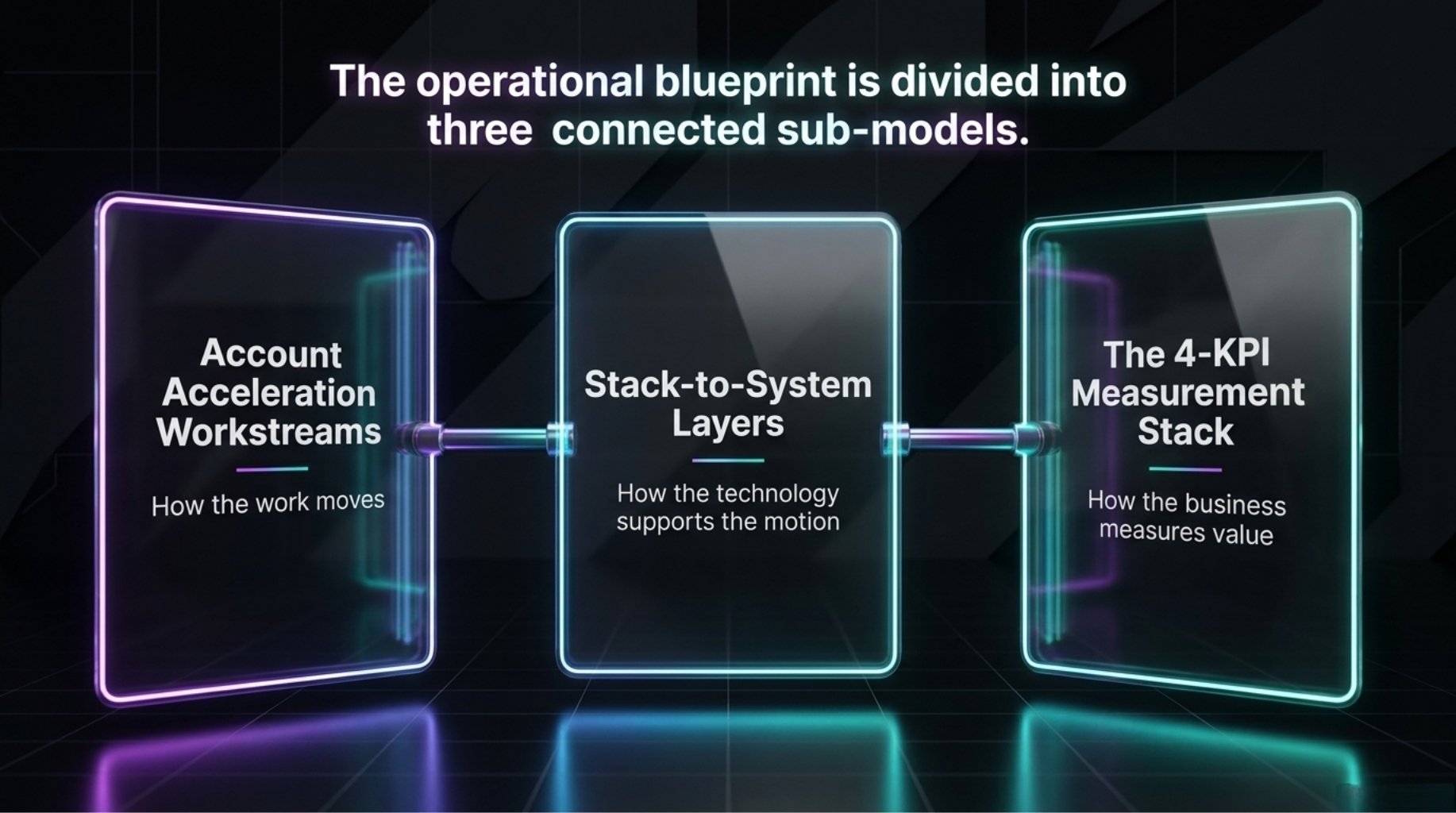
Each one answers a different operating question.
Together, they create the foundation for human-agentic GTM.
Account acceleration is rarely slowed by a lack of activity.
It is slowed by friction between steps.
Strategy does not translate cleanly into account selection.
Account selection does not translate cleanly into messaging.
Messaging does not translate cleanly into coordinated activation.
Engagement signals do not translate cleanly into SDR action.
And activity does not translate cleanly into visible account movement.
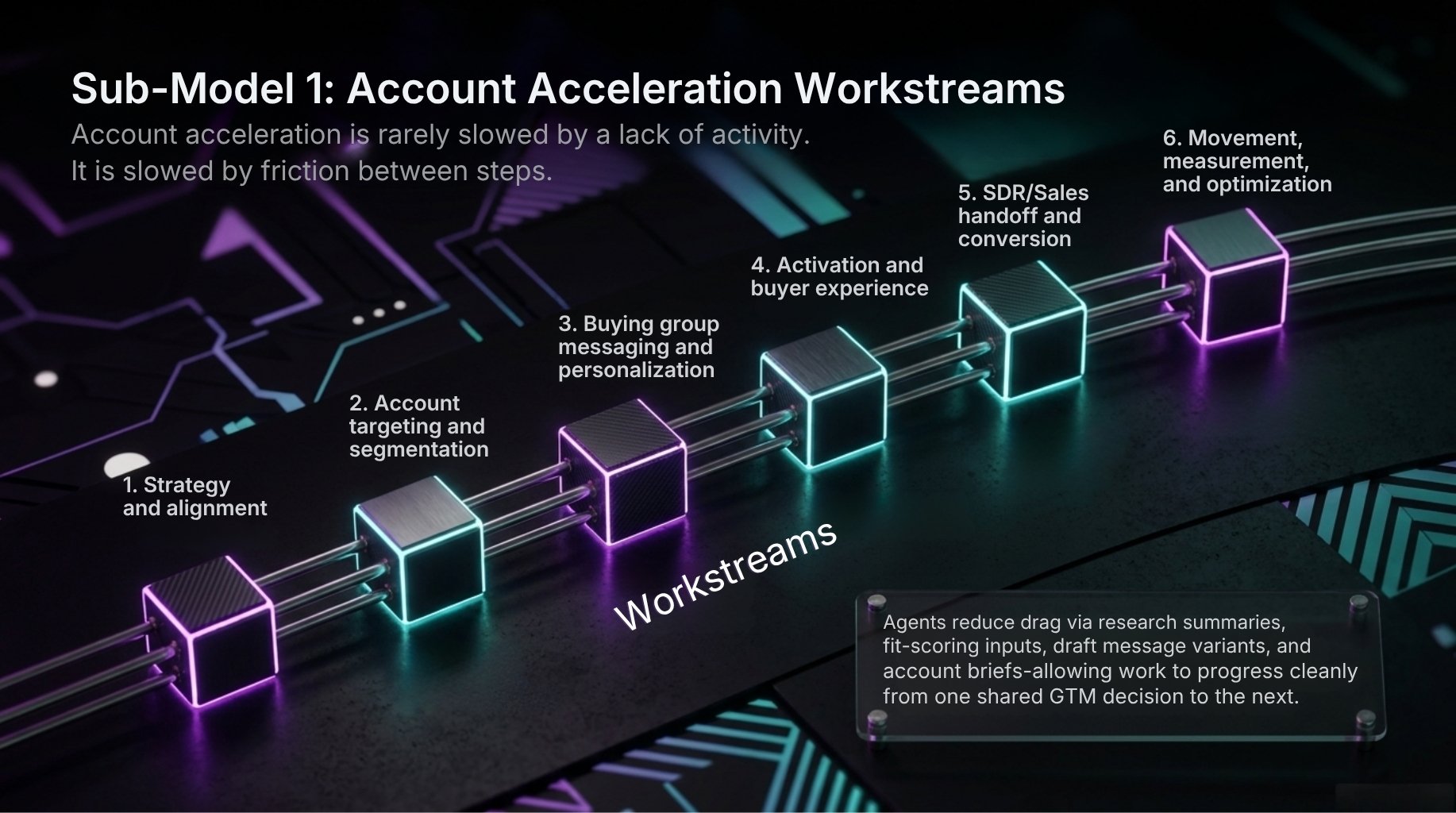
The point is not to create six new silos.
The point is to define how work progresses from one shared GTM decision to the next.
Humans still own the strategic choices:
Agents can help accelerate the repeatable work around those decisions:
That does not mean every task needs its own agent.
It means the team gets very clear on where repeatable work creates drag — and where agents can make humans faster, sharper, and better prepared.
Once the workstream is clear, the technology becomes easier to organize.
Most GTM teams already have a stack.
That does not mean they have a system.
A stack is a collection of tools.
A system has flow, logic, ownership, and accountability.
Foundation Layer | "The source of truth": CRM governance, account/contact data, ownership, lifecycle records, activity history, opportunity records, and reporting integrity.
Upstream Layer | "The intelligence layer": ICP logic, target account selection, intent, fit, buying-stage signals, stakeholder visibility, and “why this account, why now” context.
Bridge Layer | "The translation and knowledge layer": enrichment, lead-to-account matching, routing logic, approved GTM messaging, proof points, persona logic, enablement, content, talk tracks, and value-story consistency.
Midstream Layer | "The experience and activation layer": web journeys, personalization, content paths, campaign activation, audience orchestration, routing, alerts, and workflow execution.
Downstream Layer | "The conversion and learning layer": SDR/Sales handoff, pursuit readiness, meeting conversion, opportunity movement, revenue feedback loops, and performance learning.
AI Cross-Layer | "The agent workbench": research, summarization, drafting, recommendations, preparation, monitoring, and learning support across the system.
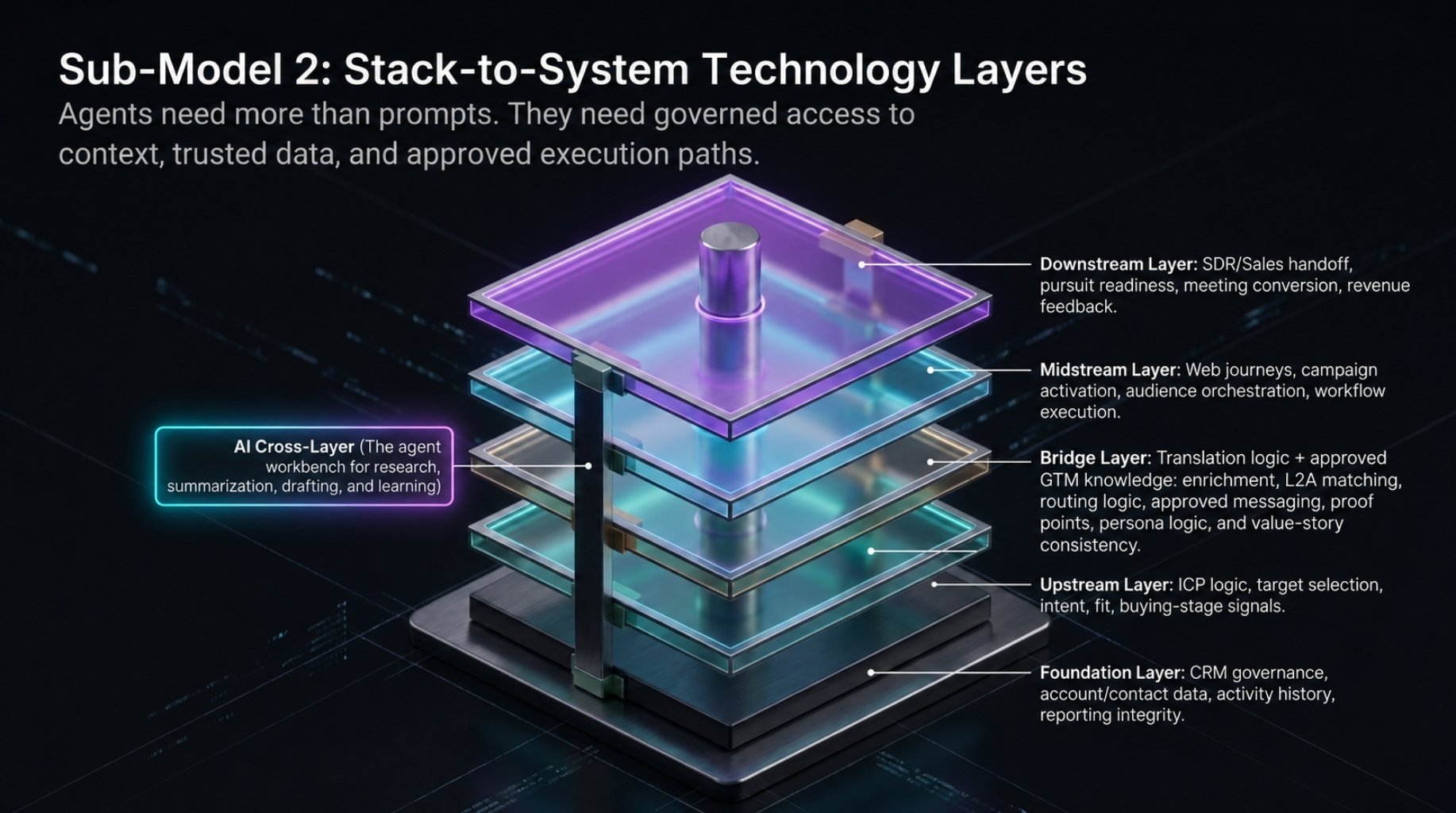
This matters because agents need more than prompts.
They need governed access to context, trusted data, approved knowledge, and clear execution paths.
Otherwise, the agent becomes just another disconnected capability in an already crowded stack.
Agent activity alone is not the outcome.
More summaries do not prove GTM is working better.
More drafts do not prove account progression.
More automated touches do not prove better pipeline quality.
The better measurement question is:
Did the work improve account readiness, handoff quality, stage movement, or revenue yield?
Coverage: Do we have the right accounts, stakeholders, data, and buying-group reach
Readiness: Are the right accounts showing meaningful buying energy?
Throughput: Are accounts moving from readiness into accepted pursuit, meetings, opportunities, and stage progression?
Yield: Is the motion creating quality revenue?

This is especially important for account-based GTM, where the “thing” we are trying to move is not one person.
It is the account.
The buying group.
The internal decision system.
That means measurement has to show movement, not just activity.
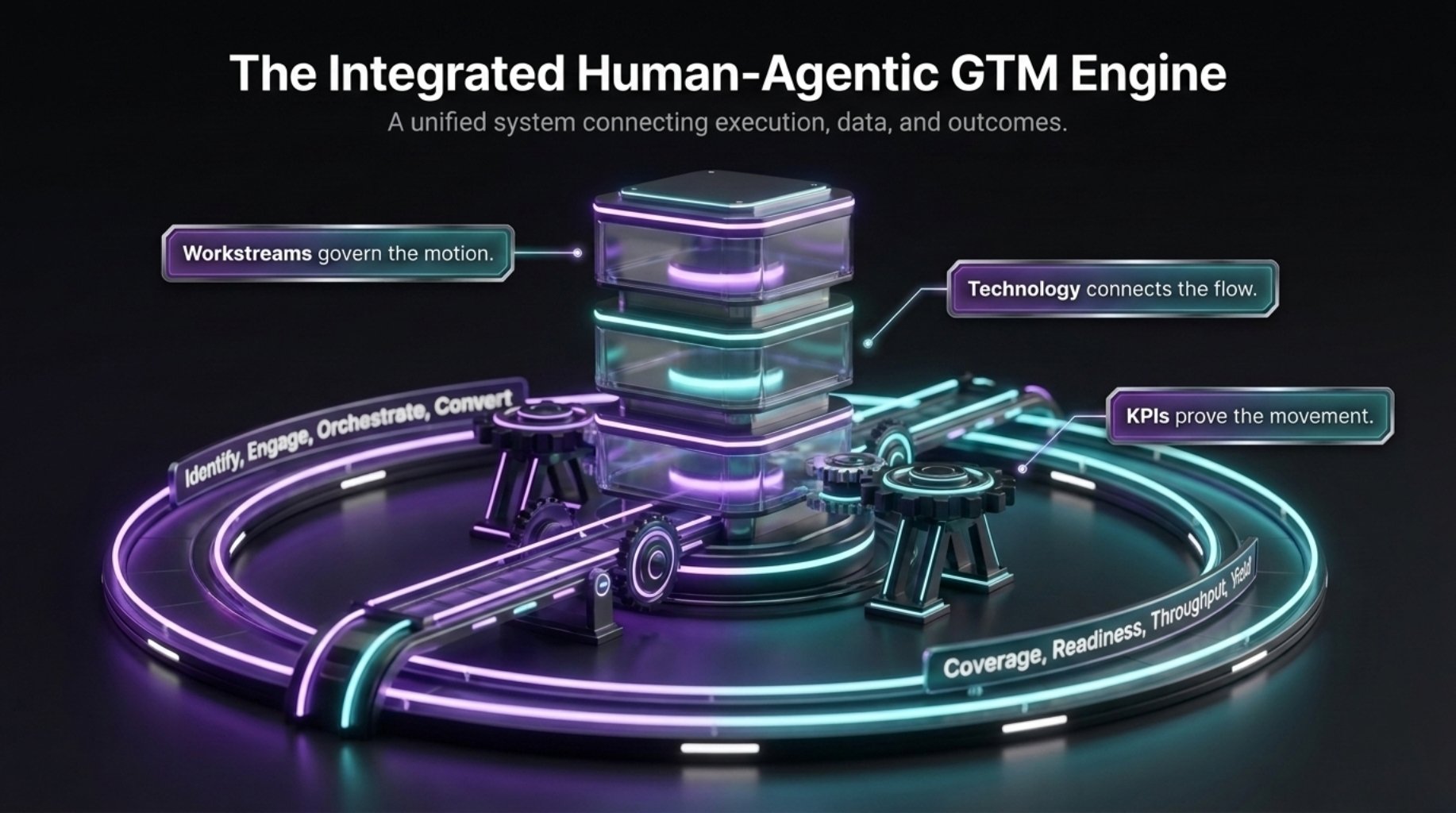
The integrated human-agentic GTM engine then serves as a unified system of connecting execution, data, and outcomes.
The future of GTM is not humans versus agents.
It is humans leading a better operating system.
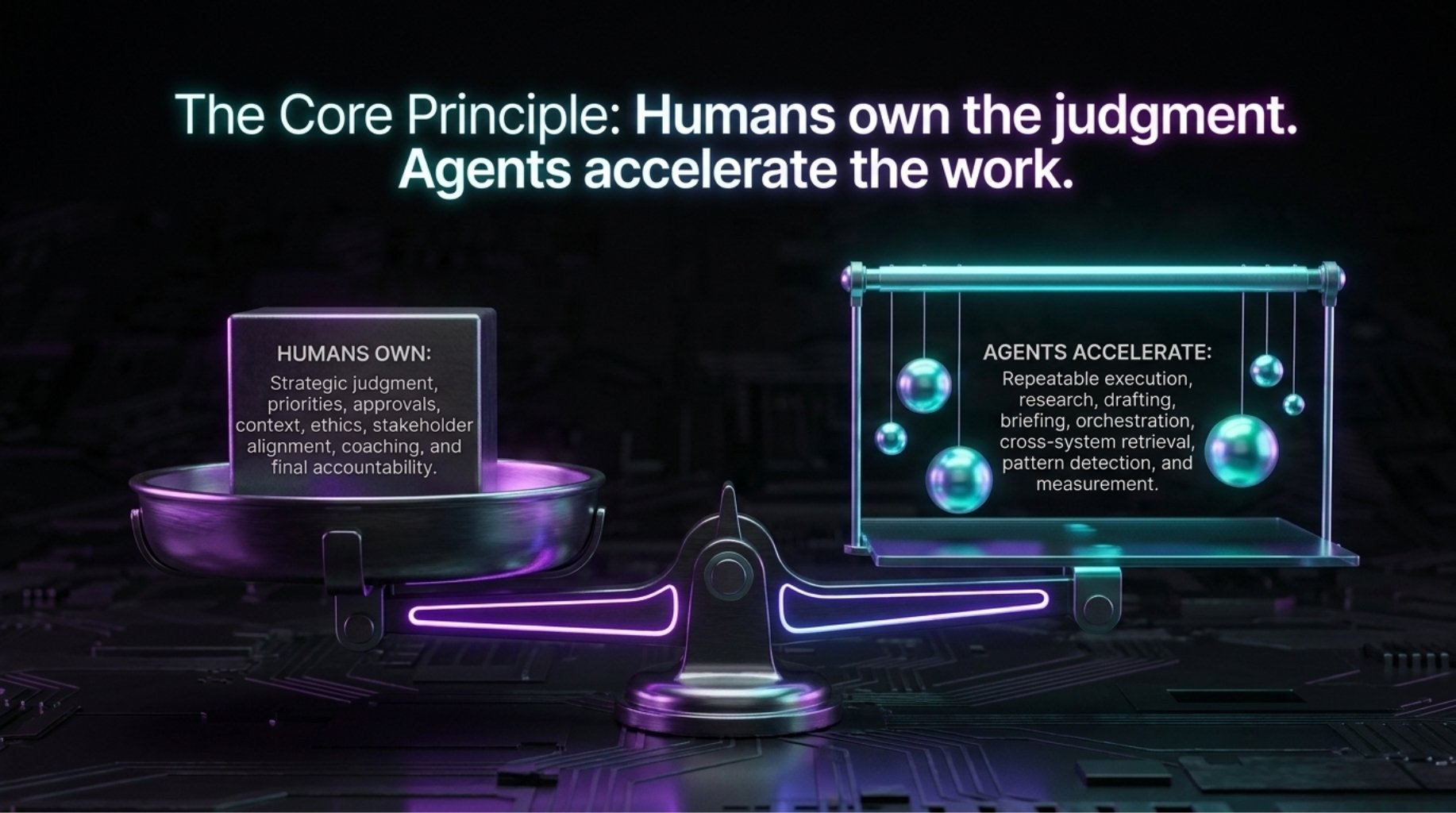
Humans remain essential wherever the work requires context, judgment, creativity, ethics, stakeholder alignment, coaching, exception handling, and final accountability.
Agents are powerful where the work requires speed, synthesis, pattern detection, repetitive preparation, cross-system retrieval, drafting, monitoring, and consistency.
👥 Humans own the judgment.
🤖 Agents accelerate the work.
⚙️ The operating model creates the accountability.
A human-agentic GTM model also needs governance.
The sequence I keep coming back to is:
Prompt → Read → Recommend → Approve → Act
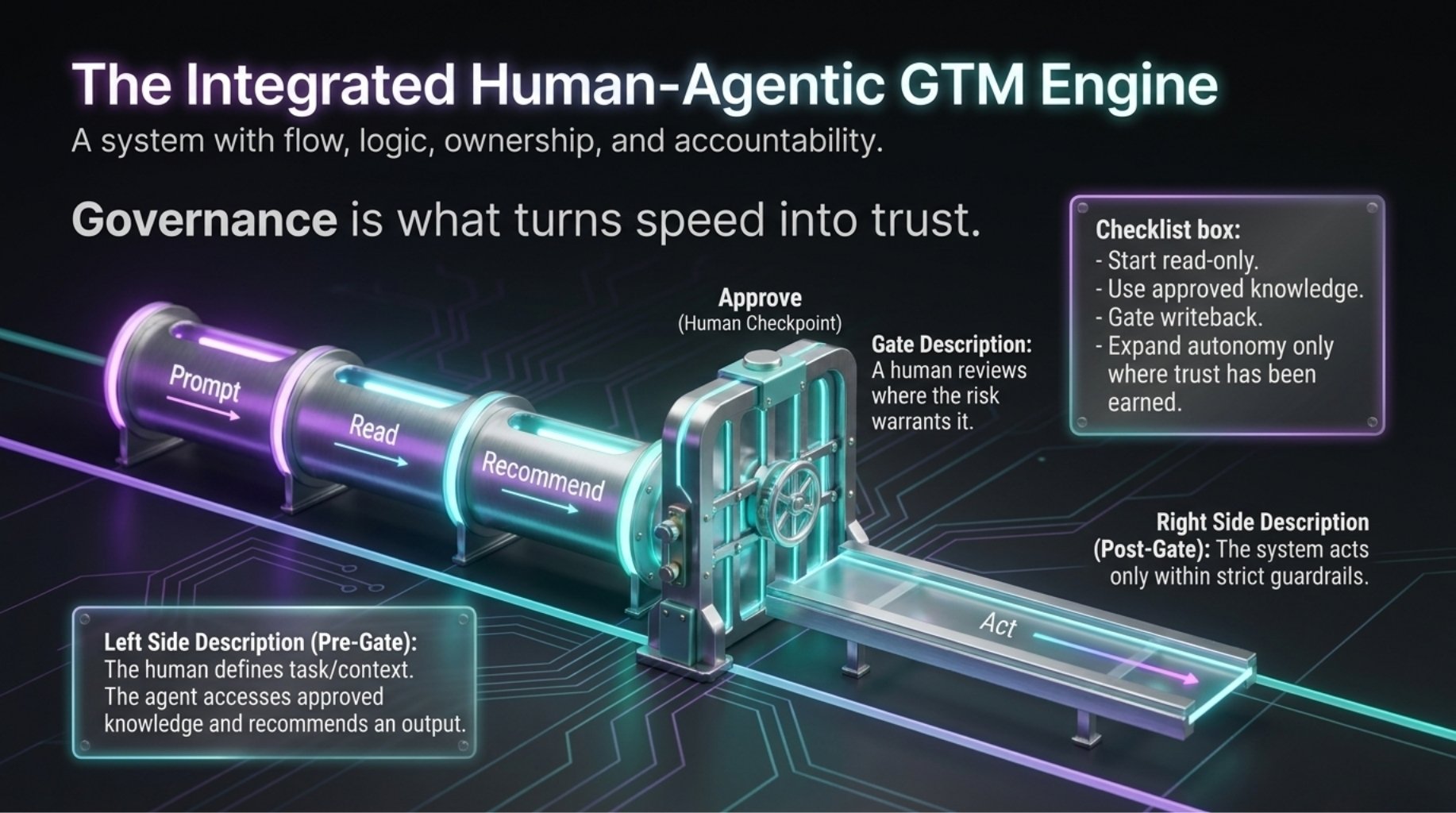
This is where many teams will need to slow down just enough to move faster safely.
The goal is not maximum automation.
The goal is trusted operating leverage.
This article frames the model primarily through the lens of acquisition and account acceleration. But the same operating-model logic can extend into expansion and retention once the core workstreams, system layers, governance model, and measurement stack are clearly defined.
The starting point does not have to be massive.
Pick one contained, strategically meaningful motion.
For example:
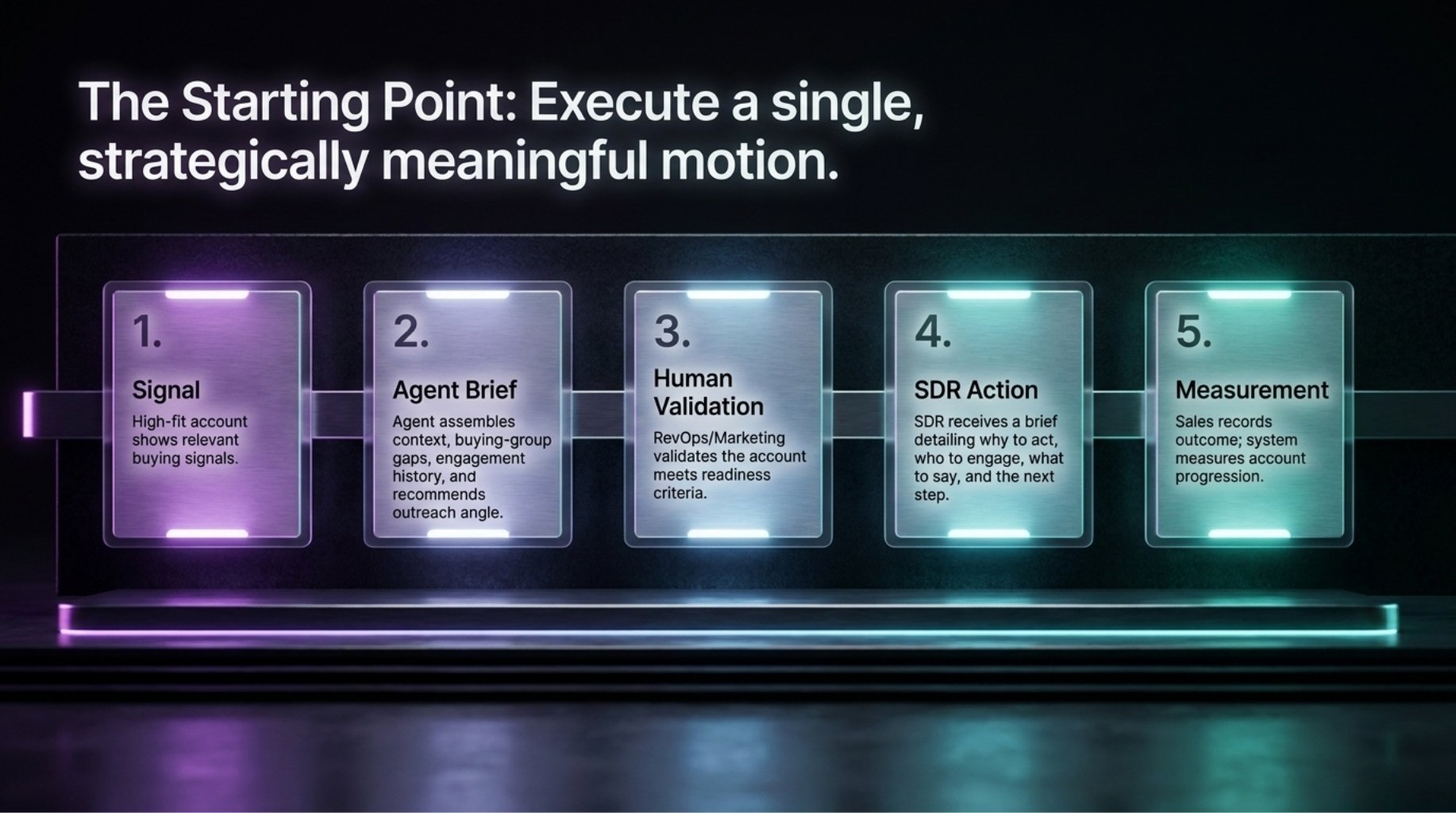
That single motion can reveal more about the operating model than months of disconnected AI experiments.
The goal is not to prove that AI magically creates revenue.
The goal is to prove that a governed human-agentic operating model can reduce execution drag, improve signal-to-action speed, strengthen SDR and Sales readiness, make handoffs more consistent, and make account movement more visible.
That is the real unlock.
Not AI layered onto the same fragmented system.
A better system — with AI built into the motion in the right places.
At the end of the day, this has to ladder up to business outcomes.
For me, a human-agentic GTM operating model should improve revenue creation, revenue protection, and operating efficiency.
New bookings — by helping teams prioritize the right accounts, act on the right signals, and create more relevant buyer interactions.
Retention and expansion — by reducing post-sale friction and surfacing the right renewal, health, and expansion triggers before they become fire drills.
Efficiency — by giving GTM teams time back: less manual research, less copy/paste reporting, less disconnected prep work, and more capacity for judgment, coaching, and strategic execution.
That is the ROI lens.
Not “How much AI are we using?”
But “Is the operating model helping the business create more revenue, protect more revenue, and reduce the drag required to get there?”
Before scaling AI agents across GTM, leaders need to ask whether the revenue engine is trusted enough to support them.
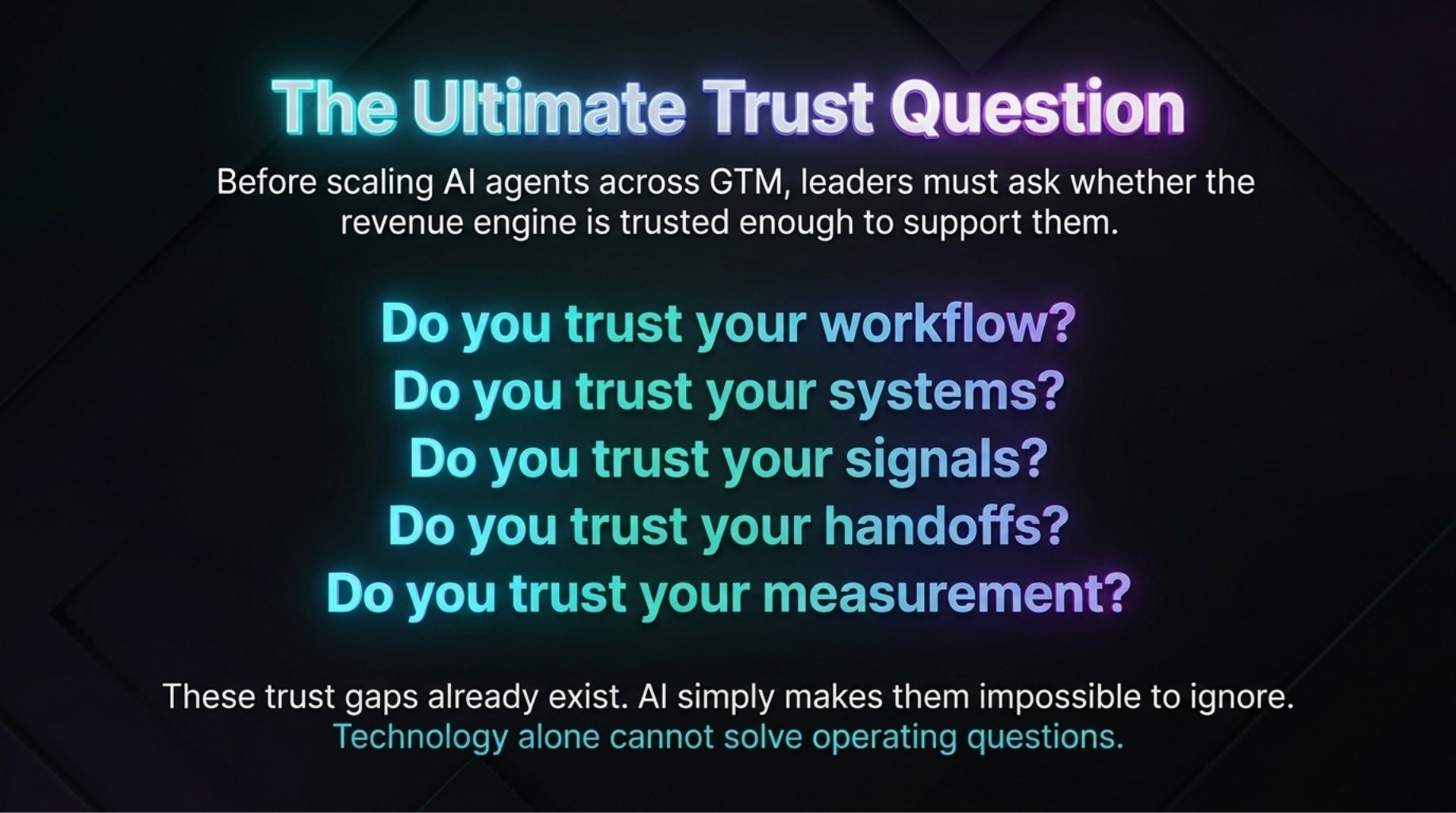
These trust gaps already exist in many organizations.
AI simply makes them harder to ignore.
And that may be one of the most valuable things about this shift.
It forces GTM leaders to confront the operating questions that technology alone could never solve.
That is why I believe human-agentic GTM is less about chasing the next AI tool and more about designing the next GTM operating model.
The future of GTM is not humans versus agents. It's humans leading a better system.
Here’s to turning your AI ambition into GTM operating reality,
~Nikke
For practical frameworks on Revenue AI, ABX, human-agentic GTM, and modern revenue operating models, subscribe to RevAI Real Talk™.
👉 Subscribe here: https://real.talk/subscribe
Real GTM. Smarter Revenue.
RevAI Real Talk™ is where B2B GTM leaders get clear, practical perspectives on what it actually takes to modernize revenue in the AI era. We break down Revenue AI, Human-Agentic GTM Organizational Design, ABM/ABX, RevOps, outbound, buying groups, data trust, and GTM operating systems to drive scalable, predictable growth — without hype, fluff, or vendor-spin. Subscribe to the feed.
 Nikke Rose: 25 Aug 2026
LinkedIn just gave GTM teams a signal of its own.
 Nikke Rose: 04 Aug 2026
Marketing can prove influence and still fail the executive trust test. The fix is not more attribution detail — it is a clearer view of revenue gaps,...
 Nikke Rose: 13 Jul 2026
Stop asking which AI is best. Start deciding which teammate should own each part of the work. The next Revenue AI advantage will come from designing...